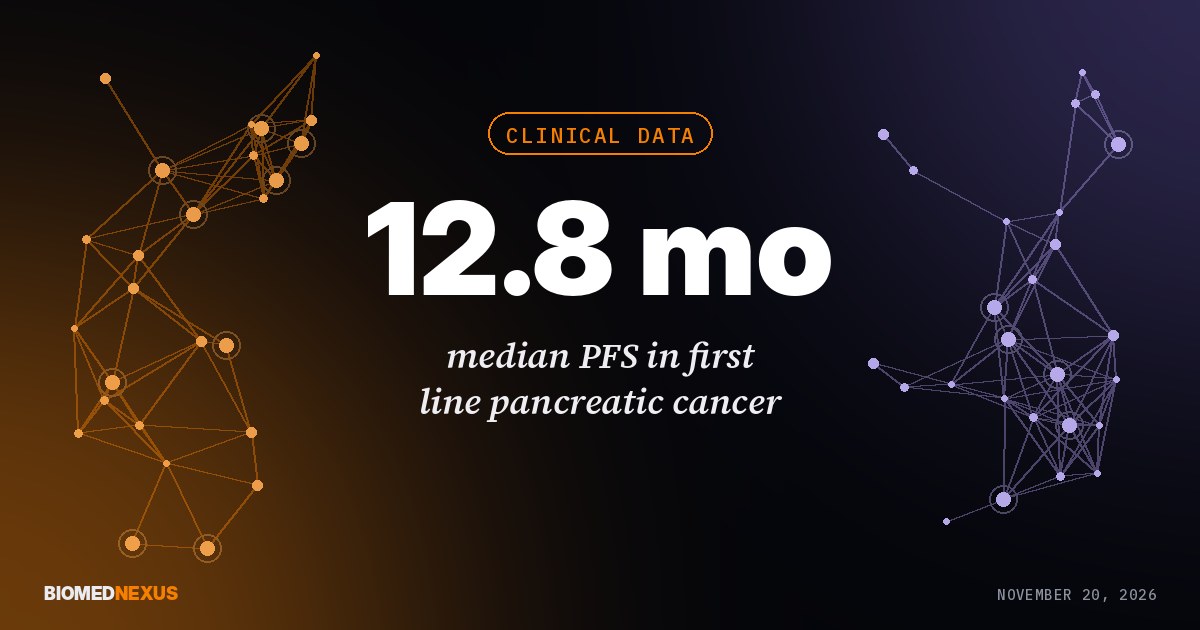
Revolution Medicines posted a 60.7% response rate and 12.8 month median PFS for Rasonque plus chemo in first line pancreatic cancer on November 19, 2026.
Last updated: November 20, 2026
Revolution Medicines reported that Rasonque (daraxonrasib) plus chemotherapy produced a 60.7% confirmed response rate, a 12.8 month median progression free survival and 76.6% survival at one year in 61 first line metastatic pancreatic cancer patients in its Phase 1/2 study.
This brief covers the Rasonque first line pancreatic cancer update, Celldex’s barzolvolimab failure in atopic dermatitis, Biohaven’s BHV-1530 data at ENA 2026, Sanofi’s Infilbray approval, the SELLAS first session after pricing, and Thursday’s notable market moves.
How effective was Rasonque plus chemotherapy in first line pancreatic cancer?
In 61 first line metastatic pancreatic cancer patients, Rasonque 200 mg plus gemcitabine and nab-paclitaxel produced a 60.7% confirmed response rate, a 90.2% disease control rate, a 12.8 month median progression free survival and 76.6% survival at twelve months.
Revolution Medicines released the updated results from its Phase 1/2 RMC-GI-102 study Thursday evening at 6:05 pm Eastern, ahead of a late breaking oral presentation (abstract 8LBA) by Dr. Wungki Park of Memorial Sloan Kettering at the EORTC NCI AACR Symposium (ENA 2026) in Barcelona. The data cutoff was September 28, 2026, with a median follow up of 18.3 months, which is long enough for the durability figures to carry real weight.
| Endpoint | Result | 95% CI |
|---|---|---|
| Confirmed objective response rate | 60.7% | 47.3 to 72.9 |
| Complete responses | 8.2% of patients | — |
| Disease control rate | 90.2% | 79.8 to 96.3 |
| Median duration of response | 11.1 months | 7.6 to 18.4 |
| Median progression free survival | 12.8 months | 10.8 to 18.4 |
| Overall survival at 12 months | 76.6% | 63.7 to 85.4 |
All figures are from the company’s release. Rasonque is a RAS(ON) multi selective inhibitor, approved in the US for metastatic pancreatic adenocarcinoma after at least one prior systemic therapy or for patients who are not candidates for multiagent chemotherapy. The FDA has granted Breakthrough Therapy Designation to the first line combination. The company said safety was consistent with the known profiles of Rasonque and the chemotherapy backbone, and the release gave no cohort specific adverse event rates.
What are the caveats in the RMC-GI-102 data?
The study is open label, single arm and small, with 61 patients in this cohort and no comparator. Response assessment is by investigators. Updated results from open label studies with limited patient numbers may not predict randomized outcomes, a caveat the company itself carries in the release.
The reference point the field will reach for is historical performance of gemcitabine plus nab-paclitaxel alone, but cross trial comparisons in pancreatic cancer are notoriously unreliable because of patient selection. The honest read is narrower: a response rate above 60% and a median progression free survival above a year are figures first line pancreatic cancer trials have simply not produced before, and whether they survive randomization is now the most important open question in gastrointestinal oncology.
What does the update mean for the RASolute 303 Phase 3 trial?
RASolute 303, the ongoing global Phase 3, tests Rasonque as monotherapy and in combination with gemcitabine and nab-paclitaxel against chemotherapy alone in treatment naive metastatic pancreatic cancer, independent of RAS genotype. Thursday’s data is the strongest evidence yet that the combination arm has a real chance.
Dr. Park called the one year survival estimate of 76.6% meaningful, and chief development officer Alan Sandler tied the durability of the update directly to the Phase 3 program. The practical stakes: pancreatic cancer is projected to become the second leading cause of US cancer death, first line standard of care has barely moved in a decade, and Revolution Medicines is running the registrational program on its own balance sheet after raising over $2 billion in 2026.
Why did Celldex stop developing barzolvolimab in atopic dermatitis?
Barzolvolimab missed the primary endpoint of its Phase 2 atopic dermatitis study at both doses. Celldex said Thursday it is discontinuing development in atopic dermatitis, concluding that mast cells contribute to the disease but are not a primary driver of it.
The study (NCT06727552) randomized 131 moderate to severe atopic dermatitis patients across 28 US centers to barzolvolimab 150 mg or 300 mg every four weeks after a 450 mg loading dose, or placebo, over a 16 week placebo controlled period. The primary endpoint was percent change in weekly average daily peak pruritus (PP-NRS) at week 16, powered at a 0.1 significance threshold.
| Arm | PP-NRS change at week 16 | Difference vs placebo | p value |
|---|---|---|---|
| Placebo | −19.5% | — | — |
| Barzolvolimab 300 mg | −29.2% | −9.7 (90% CI −21.7 to 2.4) | 0.187 |
| Barzolvolimab 150 mg | −16.2% | +3.3 (90% CI −8.7 to 15.3) | 0.651 |
Key secondary endpoints, including EASI improvement and clear or almost clear skin ratings, did not meaningfully differentiate from placebo, and week 32 data showed no improvement with longer treatment. The drug was well tolerated and suppressed tryptase rapidly and profoundly at both doses, which makes the result a clean scientific answer: the target was engaged, and the disease did not move. The release crossed at 4:01 pm Eastern, one minute after the close, so Friday is the first session in which the market prices the miss.
What happens to barzolvolimab after the atopic dermatitis failure?
The chronic spontaneous urticaria program is intact and remains the value driver. Celldex reiterated that its Phase 3 CSU trials continue to 52 weeks, a BLA submission is planned for 2027, and Phase 3 studies in cold urticaria (EMBARQ-ColdU) and symptomatic dermographism (EMBARQ-SD) are actively enrolling.
CEO Anthony Marucci pointed to what he called best in disease data in chronic spontaneous urticaria, cold urticaria and symptomatic dermographism, and the company said it will announce additional indications for barzolvolimab by year end. The atopic dermatitis result reads as a boundary on the mast cell thesis rather than a verdict on it: in diseases where mast cells are the engine, the drug has repeatedly delivered; atopic dermatitis, the company now concedes, is not one of them.
What did Biohaven report for BHV-1530 at ENA 2026?
Per Biohaven’s November 19 release, as reported by CancerNetwork, six of ten efficacy evaluable patients with activating FGFR3 alterations responded to BHV-1530, the company’s FGFR3 directed antibody drug conjugate, including three of five urothelial cancer patients and all three HPV positive head and neck cancer patients.
The figures come from the Phase 1 first in human study BHV1530-101 (NCT06874335), with an October 19, 2026 cutoff, in patients dosed at 3.3 mg/kg or higher; responses were investigator assessed and include confirmed and unconfirmed partial responses. Nine of the ten patients had tumor reductions. Two FGFR3 wild type urothelial patients also had reductions, one a response pending confirmation. Across 30 treated patients there were no dose limiting toxicities, no treatment related serious adverse events and no treatment related deaths, with nausea (43%) and fatigue (37%) the most common side effects, all low grade. Notably absent were the toxicities that define FGFR small molecule inhibitors: no hyperphosphatemia, no nail dystrophy, no retinopathy, no interstitial lung disease.
Biohaven said it completed an FDA Type C meeting in the fourth quarter and plans a pivotal study in FGFR3 altered tumors, starting with urothelial cancer, as early as the first half of 2027, aiming at possible accelerated approval. We could not retrieve the company’s release directly by publication time, so all figures here are attributed to the company via CancerNetwork’s same day report of it. Biohaven shares closed up 5.8% at $13.65 on the presentation day, our arithmetic from settled closes.
What did the FDA approve for Gaucher disease this week?
The FDA approved Sanofi’s Infilbray (venglustat) on Wednesday, November 18 as the first medicine for the neurological manifestations of Type 3 Gaucher disease, in adults and children weighing at least 15 kg. The decision came a week ahead of its November 25 action date.
Venglustat is a once daily oral glucosylceramide synthase inhibitor that crosses the blood brain barrier, which is exactly what enzyme replacement therapy cannot do. In the Phase 3 LEAP2MONO study (43 patients randomized against imiglucerase infusions), Sanofi reported superiority on a combined neurological assessment at week 52 while matching enzyme replacement on the systemic measures. The label carries warnings for suicidal ideation and behavior, lens opacification in pediatric patients and embryofetal toxicity. Sanofi has not disclosed US pricing, which we are now tracking. The approval crossed Wednesday evening after our Thursday edition was built, and it extends a remarkable run: four novel approvals in three days this week, with Klygefa on Monday, neladalkib on Tuesday and Livsayis on Wednesday. Our full explainer on the approval is linked below.
How did SELLAS trade in its first session after pricing at $13.00?
SELLAS closed Thursday at $14.86, down 17.2% from Wednesday but 14.3% above the $13.00 offering price, our arithmetic from settled closes. The first post pricing session held the issue price with room to spare.
Wednesday night’s $150 million offering priced 32.1% below Tuesday’s close, the week’s defining datapoint on what Phase 3 survival data buys a small cap: access to capital, not price. Thursday answered the follow on question, whether the book was real. A break of the issue price would have signaled a stuffed book; instead the stock settled well above it. The offering’s closing is expected Friday, November 20, and we will watch the final size for the overallotment.
Which stocks moved on Thursday, November 19?
Thursday was a hard macro session, with SPY down 2.0% while XBI slipped just 0.6%, a rare day of biotech outperformance. The moves below carry stories; percentages are our arithmetic from settled exchange closes.
| Ticker | Close | Move | Context |
|---|---|---|---|
| TEVA | $38.54 | −8.7% | First session after R&D chief Eric Hughes’s departure was announced Wednesday evening; no new company disclosure Thursday, and the broad tape was heavily negative |
| SLS | $14.86 | −17.2% | First post pricing session; held 14.3% above the $13.00 issue price |
| CAPR | $7.53 | −6.2% | Deramiocel action date is Sunday, November 22; the decision window is open |
| BHVN | $13.65 | +5.8% | BHV-1530 FGFR3 ADC data presented at ENA 2026 |
| MRK | $132.81 | −3.6% | Second leg after the nemtabrutinib discontinuation; down 7.4% over two sessions |
Revolution Medicines ($159.43) and Celldex ($27.96) both reported after the close, so Friday is the first reaction session for each. We do not print after hours prices.
What is coming next?
The nearest catalysts: the SELLAS offering closing expected Friday, November 20; Capricor’s deramiocel action date Sunday, November 22, with FDA early action possible any day; the double PDUFA on November 30 (Vertex povetacicept in IgA nephropathy and Roche’s lidERA giredestrant); and Novo Nordisk’s CagriSema decision window, still open in the fourth quarter with no announcement as of this writing. The full catalyst calendar runs in today’s Pro brief.
Frequently asked questions
What is Rasonque (daraxonrasib)?
Rasonque is Revolution Medicines’ oral RAS(ON) multi selective inhibitor, the first approved medicine targeting the active state of RAS proteins. It is approved in the US for previously treated metastatic pancreatic adenocarcinoma and is in Phase 3 development for first line disease and RAS mutant lung cancer.
What response rate did Rasonque show in first line pancreatic cancer?
A 60.7% confirmed objective response rate (95% CI 47.3 to 72.9) in 61 patients receiving Rasonque 200 mg plus gemcitabine and nab-paclitaxel, with complete responses in 8.2% of patients, per the company’s November 19, 2026 release.
What was the progression free survival for Rasonque plus chemotherapy?
Median progression free survival was 12.8 months (95% CI 10.8 to 18.4) at a median follow up of 18.3 months, with 76.6% of patients alive at one year.
Is the Rasonque first line data from a randomized trial?
No. RMC-GI-102 is an open label Phase 1/2 study, and this cohort is single arm with 61 patients. The randomized test is the ongoing Phase 3 RASolute 303 trial against chemotherapy alone.
When will RASolute 303 read out?
Revolution Medicines has not given a readout date. The trial is enrolling treatment naive metastatic pancreatic cancer patients independent of RAS genotype, with both monotherapy and combination arms.
Why did barzolvolimab fail in atopic dermatitis?
The Phase 2 study missed its itch primary endpoint at both doses (p=0.187 and p=0.651 against a 0.1 threshold) despite strong tryptase suppression, leading Celldex to conclude mast cells are not a primary driver of atopic dermatitis.
Is Celldex still filing barzolvolimab for chronic spontaneous urticaria?
Yes. Celldex says its Phase 3 CSU trials continue to 52 weeks and a BLA submission is planned for 2027, with Phase 3 studies also enrolling in cold urticaria and symptomatic dermographism.
What is BHV-1530?
BHV-1530 is Biohaven’s FGFR3 directed antibody drug conjugate carrying a proprietary topoisomerase I (TopoIx) payload. Per the company, it has produced responses in FGFR3 altered urothelial and head and neck cancers without the class toxicities of FGFR small molecule inhibitors.
When could BHV-1530 enter a pivotal trial?
As early as the first half of 2027, per Biohaven, in FGFR3 altered tumors starting with urothelial cancer, following a completed FDA Type C meeting, with possible accelerated approval as the aim.
What is Infilbray approved for?
Infilbray (venglustat) is approved for the neurological manifestations of Type 3 Gaucher disease in adults and pediatric patients weighing at least 15 kg. It is the first medicine approved for that use and was approved November 18, 2026, a week ahead of its action date.
Did SELLAS hold its offering price?
Yes. In the first session after pricing $150 million at $13.00, SELLAS closed at $14.86, 14.3% above the issue price, though 17.2% below the prior close.
When is Capricor’s deramiocel FDA decision due?
The action date is Sunday, November 22, 2026. The FDA frequently acts ahead of action dates, so a decision could come any day; no action had been announced as of Thursday night.
Why did Teva stock fall on November 19?
Teva fell 8.7% in the first session after Executive Vice President of Global R&D Eric Hughes’s departure was announced Wednesday evening, on a day the broad market fell 2.0%. We found no new company disclosure Thursday, and trade coverage attributed the move to the leadership change.
What happens on November 30?
Two FDA action dates land the same day: Vertex’s povetacicept in IgA nephropathy and Roche’s lidERA giredestrant. Both are tracked in our catalyst calendar.
Sources
Primary sources: Revolution Medicines press release, November 19, 2026 (RMC-GI-102 updated Phase 1/2 first line PDAC data). Celldex Therapeutics press release, November 19, 2026 (Phase 2 barzolvolimab atopic dermatitis results). SELLAS Life Sciences pricing release, November 18, 2026 ($150 million offering at $13.00). Sanofi press release, November 18, 2026 (Infilbray FDA approval). Biohaven release of September 28, 2026 (ENA 2026 presentation logistics). Exchange settled closing prices, November 19, 2026.
Trade coverage and attribution: CancerNetwork, November 19, 2026 (BHV-1530 ENA 2026 figures, attributed to Biohaven’s November 19 release, which we could not retrieve directly by publication time). Boston Scientific, Guardant Health and Illumina items via wire carries, November 19, 2026. Teva move context via market coverage, November 19, 2026.
Related coverage
- Livsayis wins FDA approval as first siRNA for myasthenia gravis
- Sanofi’s Infilbray approved for neurological Type 3 Gaucher disease
- SELLAS Phase 3 REGAL: 41% lower death risk in AML maintenance
- Ivonescimab CRL: the FDA demands a significant survival win
- Teva targets $6 to 7 billion in innovative revenue by 2030