Teva used its first R&D Day on November 11, 2026 to target $6 to 7 billion in innovative medicines revenue by 2030, backed by seven late stage assets.
Last updated: November 12, 2026
Teva set a target of $6 to 7 billion in innovative medicines revenue by 2030 at its first R&D Day on November 11, 2026, naming seven late stage assets it says carry more than $10 billion in combined, non risk adjusted peak sales potential.
This page covers Teva’s R&D Day in full, plus the Pfizer and Blackstone obesity funding deal, enGene’s pivotal bladder cancer data, argenx’s ACR presentation, and the rest of the November 11 tape.
What did Teva announce at its first R&D Day?
Teva Pharmaceutical Industries told investors on November 11 that it aims to generate $6 to 7 billion in innovative medicines revenue by 2030, up from a base that has more than doubled since the Pivot to Growth strategy launched in 2023 and now makes up more than 20% of company revenue. The company paired the ambition with a financial framework running through the decade.
The targets, from the company’s release (all figures except revenue are non GAAP):
| Metric | Target |
|---|---|
| Innovative medicines revenue | $6 to 7 billion by 2030 |
| Total revenue growth | Mid single digit annually, 2026 to 2030 |
| Innovative gross margin | Above 75%, driving mix shift margin expansion (total gross margin ~55% as of Q3 2026) |
| Free cash flow | More than $3.5 billion by 2030 (more than $6 billion generated 2023 to 2025) |
| Leverage | Net debt to adjusted EBITDA of 2.0x by end of 2027 |
The near term engine is the marketed trio of Austedo, Ajovy and Uzedy, which Teva expects to grow more than approximately 125% by the end of 2026 versus the strategy’s starting point, plus biosimilar revenue expected to double from 2024 to 2026. Weltruza, Teva’s olanzapine product, is described in the release as recently launched; the company again gave no pricing detail. Chief Executive Richard Francis framed the day around the transformation: with Pivot to Growth, he said, Teva set out to transform itself, and the company returned to an investment grade credit rating in 2026.
What late stage assets support Teva’s pipeline claims?
Teva says it has ten innovative programs, including two clinical stage antibodies discovered in house, and seven late stage assets with combined peak sales potential of more than $10 billion. The company’s own caveat matters and belongs next to the number: the figure is non risk adjusted, indicative, and subject to regulatory approvals.
Named program updates from the release:
| Program | Indication | Status per the release |
|---|---|---|
| Anti IL-15 antibody | Celiac disease | Phase 2a met its primary endpoint (no figures disclosed); Phase 2b expected to begin in H2 2027 |
| TEV-‘408 (anti IL-15) | Vitiligo | Advancing into a seamless Phase 2/3 later this year on encouraging Phase 1b results; alopecia being evaluated |
| ATTENUKINE (anti PD-1/IL-2) | Advanced cancer | Phase 1, with early efficacy signals and a favorable safety profile observed to date |
| Anti TSLP/IL-13 and anti TL1A/IL-23 antibodies | Asthma; inflammatory bowel disease | Early stage, discovered in house |
| Ecopipam | Pediatric Tourette syndrome | Under FDA priority review (the NDA was accepted with priority review in August 2026) |
The release did not attach efficacy figures to any clinical program, and the celiac Phase 2a result arrived without numbers. For a company asking the market to underwrite a $10 billion peak sales pipeline, the data vacuum is the thing to watch: the first program to publish real numbers will do more for the 2030 target than any framework slide. TEVA closed at 43.24, up 2.0% on the day by our arithmetic.
What are the terms of the Pfizer and Blackstone obesity funding deal?
After the close on November 11, Pfizer and Blackstone Life Sciences announced a strategic co funding agreement under which funds managed by Blackstone will pay up to a total of $1.5 billion of development costs through 2028 for berobenatide (PF’3944), Pfizer’s investigational monthly GLP-1 receptor agonist peptide for chronic weight management.
The structure is the story. Blackstone receives no rights or ownership in berobenatide and no disclosed royalty. Its return comes entirely from milestone based payments, conditioned on US regulatory approval of monthly dosing of injectable berobenatide monotherapy for chronic weight management and on certain commercial sales milestones, payable over a multi year period. Milestone amounts were not disclosed. Pfizer retains full operational control and decision making. Funds from Blackstone’s perpetual private equity strategy, BXPE, invest alongside Blackstone Life Sciences, which manages about $18 billion.
The program being funded is large: berobenatide accounts for 10 ongoing and planned Phase 3 trials, within a Pfizer plan to advance more than 20 trials for obesity and related comorbidities in 2026, including knee osteoarthritis and obstructive sleep apnea, and combinations with nutrient stimulated hormone peptides including amylin analogs. Pfizer Chief Financial Officer Cecile Guegan said the approach pairs internal research investment with targeted capital from partners, and Blackstone Life Sciences head Nicholas Galakatos called berobenatide the anchor of Pfizer’s cardiometabolic pipeline. The announcement came after the close; Thursday is the first session where the market can react. The structure follows the same playbook Blackstone ran with Boston Scientific in October, a $455 million agreement to co fund heart pump development, as reported by MedTech Dive.
What did enGene report from the LEGEND trial in bladder cancer?
Also after the close on November 11, enGene reported updated pivotal Cohort 1 data from the LEGEND trial of detalimogene voraplasmid, its non viral plasmid gene therapy for BCG unresponsive non muscle invasive bladder cancer with carcinoma in situ, and said it will initiate a rolling BLA submission by the end of 2026, complete it in the first half of 2027, and sees potential FDA approval in 2027. The company says it reached alignment with the FDA on key BLA components, including the efficacy evaluable population, after a pre BLA meeting.
The dataset, at an October 29, 2026 cutoff, with 125 patients enrolled and 120 efficacy evaluable, against the April 2026 analysis as stated in the release:
| Endpoint | November 2026 | April 2026 |
|---|---|---|
| Complete response at any time | 56% (CI 47 to 65) | 54% |
| Landmark complete response at 12 months | 24% (CI 16 to 33) | 13% |
| Kaplan Meier duration of response of at least 12 months | 43% (CI 30 to 55), preliminary | 25% |
| Median duration of complete response | 10.1 months (CI 7.5 to not estimable) | 8.6 months |
Median follow up for responders reached 12.0 months. Among all efficacy evaluable patients, 97% remained free of progression to muscle invasive or metastatic disease and 86% remained free of cystectomy; among responders those figures were 100% in the bladder and 96%. Safety across 125 patients: 59% had at least one treatment related adverse event, mostly grade 1 or 2, with fatigue (21%), dysuria (16%) and pollakiuria (16%) most common; grade 3 events were 4%, serious events 2%, and there were no grade 4 or 5 events. Chief Executive Ron Cooper said efficacy sits within range of approved products for the indication, without naming comparators, and pointed the commercial plan at community urology practices, where he says more than 75% of these patients receive care. The program holds RMAT and Fast Track designations and was selected for the FDA’s CMC Development and Readiness Pilot. ENGN closed at 1.80 before the news; Thursday is the first reaction session. The indication is contested ground: Adstiladrin, Anktiva and Keytruda already hold approvals in BCG unresponsive disease, and the FDA’s draft guidance rethink for the space remains pending.
What did argenx present at ACR Convergence 2026?
argenx presented its Phase 3 ALKIVIA results in autoimmune myositis as a late breaking oral presentation on November 11, filling in the subtype detail behind the topline it released ahead of the congress. The seamless Phase 2/3 study randomized 265 patients with immune mediated necrotizing myopathy, dermatomyositis or polymyositis to weekly subcutaneous efgartigimod (Vyvgart Hytrulo) or placebo on background therapy, with a protocol mandated steroid taper in the Phase 3 portion. The combined primary endpoint stood at a 15.4 point greater improvement in Total Improvement Score at week 52 (48.0 versus 32.6, p=0.0011).
The subgroup split is what changed hands this week. In IMNM, efgartigimod beat placebo by 14.8 points (45.1 versus 30.2, p=0.0048), with a 22.0 percentage point advantage in patients reaching a Total Improvement Score of at least 40, a 5.4 point edge on muscle strength by MMT-8, and a 43.5 percentage point greater reduction in creatine kinase. In dermatomyositis, the 14.5 point difference (51.5 versus 37.0) did not reach significance (p=0.1093) in what the company calls a smaller cohort, though response rate and skin score measures favored the drug. argenx plans a supplemental BLA for IMNM by the end of 2026, supported by Breakthrough Therapy Designation; there are no approved selectively targeted treatments in myositis, which the company sizes at about 100,000 US patients, roughly 20,000 of them with IMNM. ARGX closed at 977.58, up 0.6%, a muted reaction consistent with data the market had already seen.
What else happened in biotech and medtech on November 11, 2026?
A busy tape beyond the headliners, anchored by two bladder cancer events in one day and a quiet vaccine acquisition surfacing from Monday.
AstraZeneca acquired Omniose. The Missouri based preclinical biotech announced Tuesday, November 10 that it has been acquired by AstraZeneca and will operate as a wholly owned subsidiary inside the Infectious Disease Unit. Omniose’s bioconjugation platform builds polysaccharide conjugate vaccines in a single engineered E. coli cell, which the company calls much simpler than conventional chemical conjugation. The deal follows a three year exclusive research collaboration that began in 2024, per Pharmaceutical Technology. Terms were not disclosed.
The FDA approved Pimjetmi for tenosynovial giant cell tumor. The November 10 approval of pimicotinib makes it the first once daily CSF1R inhibitor and the third CSF1R drug in the indication. Our full explainer is in Pimjetmi approved as first once daily CSF1R drug for TGCT.
Virtuoso Surgical won a de novo authorization. The FDA authorized the company’s robotic system for endoscopic en bloc resection of bladder tumors, the first device in a new classification for electromechanical endoluminal surgical systems, per Virtuoso via MedTech Dive. In the first 20 patients of its VIABLE study, detrusor muscle was present in 94% of removed lesions against a 60% performance goal. A focused US launch is planned for 2027.
Guardant Health proposed a $500.0 million offering of convertible senior notes due 2032 after the close, extending the week’s run of capital raises across diagnostics and biotech.
Karyopharm’s Nasdaq suspension took effect. The delisting followed the Chapter 11 filing, with Ayrmid, the parent of Gamida Cell, positioned as lead bidder in the court supervised auction per BioPharma Dive. Prime Medicine’s $125.0 million offering is expected to close on or around November 12.
Which biotech stocks moved on November 11, 2026?
Settled closes, movers only; percentages are our arithmetic against Tuesday’s closes.
| Ticker | Close | Move | Context |
|---|---|---|---|
| TEVA | 43.24 | +2.0% | First R&D Day; 2030 framework landed politely, not euphorically |
| SMMT | 16.64 | −6.7% | Slid into the November 14 ivonescimab action date; no company disclosure; a reported new OS analysis has raised an extension question, per Fierce Biotech |
| PEPG | 5.26 | +15.9% | Second session of follow through on the DM1 splicing data |
| PRME | 4.30 | +10.3% | First session after pricing the $125.0 million offering at $3.50 |
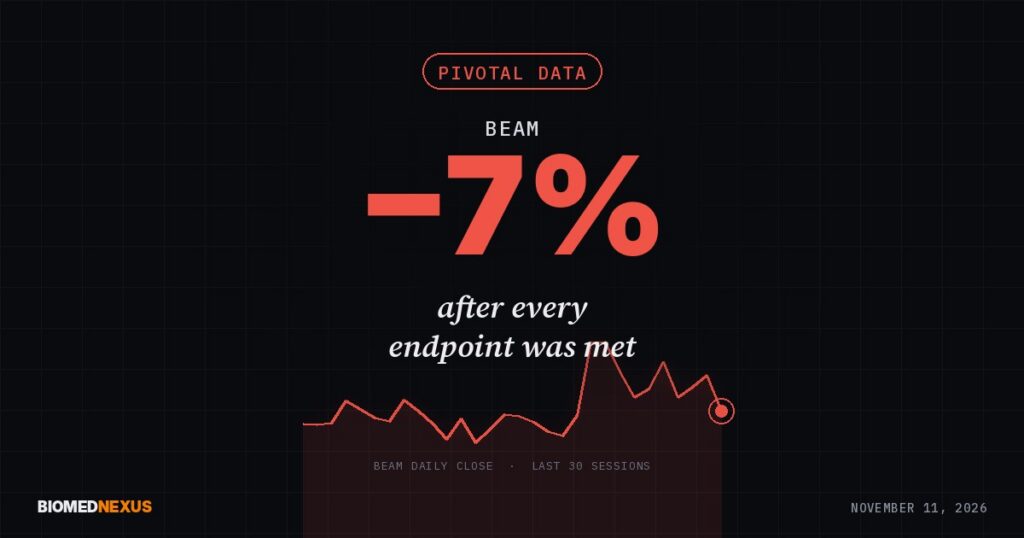
| BEAM | 25.81 | +2.6% | Stabilizing two sessions after the BEACON readout; no offering has appeared |
| XBI | 156.31 | +0.8% | Sector context; SPY +1.3% |
Frequently asked questions
What is Teva’s innovative medicines revenue target for 2030?
$6 to 7 billion, announced at the company’s first R&D Day on November 11, 2026. Innovative medicines currently contribute more than 20% of Teva’s revenue after more than doubling since 2023.
Which products drive Teva’s innovative growth today?
Austedo, Ajovy and Uzedy, which Teva expects to grow more than approximately 125% by the end of 2026, plus the recently launched Weltruza (olanzapine). Biosimilar revenue is expected to double from 2024 to 2026.
What is in Teva’s late stage pipeline?
Teva counts seven late stage assets with combined non risk adjusted peak sales potential above $10 billion, including ecopipam under FDA priority review for pediatric Tourette syndrome, an anti IL-15 program in celiac disease and vitiligo, and the ATTENUKINE anti PD-1/IL-2 program in oncology.
Is ecopipam approved for Tourette syndrome?
No. The FDA accepted Teva’s new drug application and granted priority review in August 2026. Ecopipam remains investigational for pediatric patients with Tourette syndrome.
What is berobenatide?
Berobenatide (PF’3944) is Pfizer’s investigational monthly injectable GLP-1 receptor agonist peptide for chronic weight management, in 10 ongoing and planned Phase 3 trials, studied alone and with nutrient stimulated hormone peptides including amylin analogs.
How much is Blackstone paying toward Pfizer’s obesity program?
Funds managed by Blackstone will pay up to $1.5 billion of berobenatide development costs through 2028 under the strategic co funding agreement announced November 11, 2026.
Does Blackstone get ownership of berobenatide?
No. Blackstone acquires no rights or ownership in the drug. It is eligible for undisclosed milestone payments tied to US approval of monthly berobenatide monotherapy dosing and to commercial sales milestones, payable over a multi year period.
What is detalimogene voraplasmid?
Detalimogene voraplasmid is enGene’s non viral plasmid gene therapy, delivered into the bladder, for BCG unresponsive non muscle invasive bladder cancer with carcinoma in situ. It holds RMAT and Fast Track designations.
What complete response rate did detalimogene show in the LEGEND trial?
56% of 120 efficacy evaluable patients achieved a complete response at any time, with a 24% landmark complete response rate at 12 months and a preliminary Kaplan Meier estimate that 43% of responses last at least 12 months, at an October 29, 2026 cutoff.
When will enGene file for FDA approval of detalimogene?
enGene plans to initiate the BLA by the end of 2026 and complete the submission in the first half of 2027, with potential FDA approval in 2027.
What did the ALKIVIA trial show in myositis?
Efgartigimod beat placebo by 15.4 points on Total Improvement Score at week 52 in the combined IMNM and dermatomyositis population (p=0.0011). The IMNM subgroup was significant at 14.8 points (p=0.0048); the dermatomyositis subgroup was not (p=0.1093).
When will argenx file efgartigimod for IMNM?
argenx plans to submit a supplemental BLA to the FDA for immune mediated necrotizing myopathy by the end of 2026, supported by Breakthrough Therapy Designation.
Why did AstraZeneca buy Omniose?
To own the bioconjugation platform it had worked with under an exclusive collaboration since 2024. Omniose builds polysaccharide conjugate vaccines against bacterial pathogens in a single engineered cell, and becomes part of AstraZeneca’s Infectious Disease Unit. Terms were not disclosed.
What did the FDA approve for tenosynovial giant cell tumor this week?
Pimjetmi (pimicotinib), approved November 10, 2026, the first once daily CSF1R inhibitor for symptomatic TGCT.
When is the FDA decision on Summit’s ivonescimab?
The scheduled action date is November 14, 2026, which falls on a Saturday, so the practical window is Friday, November 13 or early the following week; BioXcel’s Igalmi sNDA shares the same date. A reported new overall survival analysis has raised the possibility of a review extension, per Fierce Biotech, and the agency has also acted early repeatedly this year.
Sources
Primary sources: Teva Pharmaceutical Industries R&D Day press release (GlobeNewswire, November 11, 2026); Pfizer and Blackstone Life Sciences press release (Business Wire, November 11, 2026); enGene Therapeutics press release (Business Wire, November 11, 2026); argenx ALKIVIA data press release (GlobeNewswire, November 7, 2026, presented November 11); Omniose press release (Business Wire, November 10, 2026); Guardant Health offering announcement (November 11, 2026).
Trade press and market data: Pharmaceutical Technology (November 11, 2026, Omniose collaboration history); MedTech Dive (November 10, 2026, Virtuoso Surgical de novo; October 2026, Boston Scientific and Blackstone); BioPharma Dive (Karyopharm auction); Fierce Biotech (Summit HARMONi OS analysis report, attributed); exchange settled closing prices via Robinhood market data, November 11, 2026. Percentage moves are our arithmetic.
Related coverage
- Beam’s sickle cell base editor met every pivotal endpoint
- Argenx buys Unnatural Products for $550 million upfront
- Pimjetmi approved as first once daily CSF1R drug for TGCT
- The FDA approved Anktiva in papillary only bladder cancer without a randomized trial
- CorMedix to buy Heron’s assets in $222.6 million upfront deal