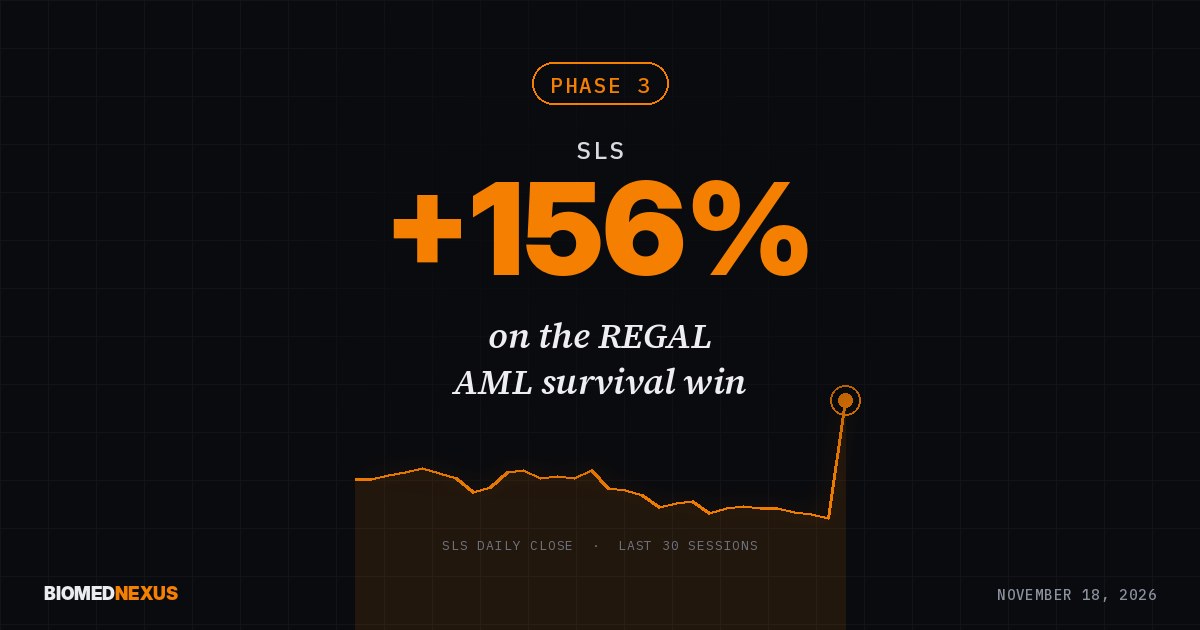
SELLAS’ galinpepimut-S cut the risk of death 41% in the Phase 3 REGAL AML trial on November 17, 2026. The stock rose 156.4%, then came a $150M offering.
Last updated: November 18, 2026
In the Phase 3 REGAL trial, SELLAS’ galinpepimut-S extended median overall survival to 24.0 months versus 14.7 for best available treatment in AML maintenance, a hazard ratio of 0.59 (p=0.035). The stock rose 156.4%, and SELLAS then launched a $150 million offering.
This page covers the REGAL results and the same day financing, Merck’s discontinuation of the nemtabrutinib program, the Wilserdly (giredestrant) approval, the GSK neladalkib approval, the ObesityWeek closeout from Corbus and Rhythm, the BioXcel watch, and the November 17 movers.
What did the SELLAS REGAL Phase 3 trial show in AML?
Galinpepimut-S maintenance extended median overall survival to 24.0 months versus 14.7 months for best available treatment in AML patients in second or later complete remission who could not undergo transplant, a 41% reduction in the risk of death (HR 0.59, two sided p=0.035).
REGAL (NCT04229979) is a global, randomized, open label registrational trial that enrolled 126 patients who reached a second or later complete remission (CR2 or CRp2) after salvage therapy and were ineligible for, or unable to undergo, allogeneic stem cell transplantation. Patients were randomized 1:1 to galinpepimut-S (GPS), a WT1 targeting immunotherapeutic built from four WT1 derived peptides and licensed from Memorial Sloan Kettering, or to investigator’s choice of best available treatment, which could be observation, a hypomethylating agent, venetoclax, low dose cytarabine, or combinations of those. The primary endpoint was overall survival, and the topline analysis ran at the prespecified 80th death.
| REGAL topline at 80 deaths | GPS maintenance | Best available treatment |
|---|---|---|
| Median overall survival | 24.0 months | 14.7 months |
| Hazard ratio for death | 0.59, a 41% reduction (two sided p=0.035) | |
| Randomized | 126 patients, 1:1 (per arm counts not disclosed) | |
| Population | AML in CR2 or later after salvage therapy, transplant ineligible | |
| Safety | Generally well tolerated; treatment related adverse events mostly grade 1 or 2 injection site reactions; no new signals (no rates disclosed) | |
The company said both arms were well balanced on prognostic stratification factors and that stem cell transplants during the trial were limited in number and evenly distributed. SELLAS plans to meet the FDA to discuss an accelerated filing strategy and targets a BLA submission in the first half of 2027. There is currently no approved maintenance standard in this setting.
What are the caveats in the REGAL data?
The release reports a single efficacy readout with no confidence interval, no per arm patient counts, no secondary endpoints and no survival curves, from an open label trial against a mixed comparator. The result is strong but incomplete until the full dataset is presented.
Specifics worth holding onto. First, the comparator is a bundle: observation, hypomethylating agents, venetoclax and low dose cytarabine are different levels of care, and how patients distributed across them is not yet public. Second, the two sided p value of 0.035 comes from an analysis at 80 deaths; the hazard ratio’s confidence interval was not disclosed. Third, secondary endpoints, including leukemia free survival, measurable residual disease and immune response dynamics, are still being analyzed, with the company promising a medical conference presentation and a peer reviewed publication. Fourth, the release discloses that Memorial Sloan Kettering has institutional financial interests in SELLAS and that two named physicians involved with the program hold financial interests. None of this undoes a survival hazard ratio of 0.59 in a setting with no approved option; it defines what still has to hold up when the complete data appear.
What is the $150 million offering SELLAS announced the same day?
About nine hours after the topline release, SELLAS commenced a $150.0 million underwritten public offering of common stock, with a 30 day underwriters’ option for up to $22.5 million more. J.P. Morgan and TD Cowen are joint book running managers. Price and share count were not stated.
The offering runs off a shelf registration on Form S-3 (File No. 333-294504) that became automatically effective on filing in March 2026. The announcement did not state use of proceeds; those details come with the preliminary prospectus supplement. The sequencing is the story for the broader market: SELLAS closed Monday at 7.47, printed data at 7:00 am Tuesday, held a 156.4% gain through the close at 19.15 on roughly 118 million shares of volume (our arithmetic from exchange settled closes and exchange volume), and launched the raise at 4:01 pm. Where the deal prices on Wednesday is the first hard read on whether institutions will fund clinical winners at post data prices.
Why did Merck discontinue nemtabrutinib and the BELLWAVE program?
Merck discontinued the entire nemtabrutinib clinical program after an external data monitoring committee reviewing the Phase 3 BELLWAVE-011 trial in CLL found the benefits may not outweigh the risks, a conclusion Merck says it confirmed on review of the totality of the data.
Nemtabrutinib (MK-1026) is an oral, non covalent BTK inhibitor that came to Merck with its acquisition of ArQule and was in development for chronic lymphocytic leukemia, small lymphocytic lymphoma and other blood cancers. The November 17 release, issued after the market close, names the trials below. No efficacy or safety figures were disclosed; Merck says analyses are ongoing and results will be shared with the scientific community, and that study investigators are informing patients about next steps.
| Trial | Registry | Status per the release |
|---|---|---|
| BELLWAVE-011 (Phase 3, CLL) | NCT06136559 | Discontinued; the trial whose eDMC review triggered the decision |
| BELLWAVE-008 (Phase 3) | NCT05624554 | Discontinued with the broader program |
| BELLWAVE-010 (Phase 3) | NCT05947851 | Discontinued with the broader program |
| Other BELLWAVE studies and waveLINE-006 | Multiple | Named as nemtabrutinib trials; release language ends development across the entire clinical program |
A benefit risk conclusion from a data monitoring committee is a different ending than a missed endpoint: it speaks to the therapeutic trade itself in a disease with established alternatives, and Merck ending development in every setting at once indicates the company read the problem as belonging to the molecule. Wednesday, November 18 is the first session for Merck shares after the news; the stock closed at 143.37, down 0.8%, before the release crossed.
What did the FDA approve Wilserdly (giredestrant) for?
On Monday evening the FDA approved Genentech’s Wilserdly (giredestrant), an oral selective estrogen receptor degrader, in combination with everolimus for adults with ER positive, HER2 negative, ESR1 mutated locally advanced or metastatic breast cancer whose disease recurred during or after adjuvant endocrine therapy or progressed on an endocrine regimen.
The approval rests on the Phase 3 evERA Breast Cancer trial (NCT05306340), published in the New England Journal of Medicine, which compared the all oral combination against standard endocrine therapy plus everolimus in patients previously treated with a CDK4/6 inhibitor. The release reports a 62% reduction in the risk of progression or death (stratified hazard ratio 0.38, 95% confidence interval 0.27 to 0.54, p<0.0001); it does not report medians, overall survival, or results for the overall intention to treat population. The indication requires ESR1 mutation detection by an FDA authorized test. Named safety items include bradycardia, cytopenias, liver enzyme elevations and stomatitis. Genentech expects US availability within weeks. The companion decision to watch is November 30, 2026: giredestrant’s separate adjuvant application, based on the Phase 3 lidERA study, is under priority review with an action date that day. For how oral SERDs fit the ESR1 resistance landscape, see our explainer linked below.
What did the FDA approve for GSK’s neladalkib?
Tuesday evening, ten days ahead of its November 27 action date, the FDA granted accelerated approval to GSK’s Nelkarmi (neladalkib) for locally advanced or metastatic ALK positive NSCLC previously treated with alectinib as the only prior ALK TKI, or with two or more ALK TKIs and platinum based chemotherapy.
The approval rests on the single arm Phase 1/2 ALKOVE-1 trial (NCT05384626), with 222 patients in the primary efficacy analysis. Confirmed response rates by blinded review were 49% (33 of 67) in patients whose only prior ALK TKI was alectinib and 32% (50 of 155) after two or more TKIs plus chemotherapy, with responses lasting 12 months or more in about half of responders in both groups. Intracranial response rates in patients with measurable brain metastases were 55% and 26%. Hepatotoxicity was the most common adverse reaction at 56%, and 5% of patients discontinued for adverse reactions. Continued approval may depend on confirmatory evidence; the Phase 3 ALKAZAR trial in TKI naive patients is underway. Neladalkib came to GSK with its Nuvalent acquisition, and the 5:00 pm release makes Wednesday the first session to price it. The agency acting ahead of the target date, again, is the standing reminder that this calendar runs on targets, not deadlines.
What did Corbus’ CANYON-1 trial show for CRB-913 in obesity?
In the Phase 1b CANYON-1 study, Corbus’ peripherally restricted CB1 inverse agonist CRB-913 produced 5.0% placebo adjusted weight loss at week 12 at the 60 mg dose (p<0.0001), with no serious treatment related adverse events and no suicidality, and adverse event discontinuations near 13% at the two higher doses.
CANYON-1 (NCT07310901) randomized 254 non diabetic adults with obesity 1:1:1:1 to placebo or CRB-913 at 20, 40 or 60 mg once daily across 15 US sites, with 12 weeks of dosing and four weeks of follow up. The results were presented as an ObesityWeek 2026 poster and released Monday morning, November 16.
| Arm | Weight change, week 12 (LS mean) | Stopped for adverse events |
|---|---|---|
| Placebo (n=66) | 0.0% | 4.5% |
| CRB-913 20 mg (n=65) | −2.8% (p<0.0001) | 3.1% |
| CRB-913 40 mg (n=61) | −3.3% (p<0.0001) | 13.1% |
| CRB-913 60 mg (n=62) | −5.0% (p<0.0001) | 12.9% |
On the 60 mg arm, 44.4% of completers lost at least 5% of body weight. Psychiatric events, the historic liability of CB1 drugs, were infrequent and mostly mild per the release, with one moderate depressive episode at 60 mg and no suicidality in any arm. The release table also shows nausea in the 15% to 26% range across active arms versus 4.5% on placebo and diarrhea in the 22% to 26% range versus 3.0% on placebo. Corbus plans FDA engagement and says it is evaluating CRB-913 in combination with GLP-1 therapies; no Phase 2 timing was given. The market graded it coolly: Corbus closed the data day roughly flat at 3.375, then fell 10.8% to 3.01 on Tuesday (our arithmetic from settled closes).
What did Rhythm present at ObesityWeek 2026?
Rhythm presented two year results from the Phase 3 TRANSCEND long term extension showing continuous setmelanotide held a mean BMI reduction of 18.8% in acquired hypothalamic obesity, and a 17 expert panel published the first consensus definition and diagnostic criteria for the disease.
Of 125 patients who entered the extension, 81 had completed two years at the analysis: patients on continuous setmelanotide held a mean BMI change of −18.8%, while patients who crossed over from placebo after one year reached −16.5%. Adults in the two groups reached −21.2% and −21.0%, and pediatric BMI z scores fell 1.71 and 1.49. The release reports no comparator statistics for the extension. The consensus work defines acquired hypothalamic obesity as weight gain following hypothalamic or pituitary injury in children and adults, with or without hyperphagia, a document whose practical effect is to help clinicians find patients for an approved drug. Rhythm’s stock rose 8.5% to 116.61 on Tuesday, the first full session after the Monday release.
What is the status of BioXcel’s Igalmi at home sNDA?
Three days past the November 14, 2026 action date, BioXcel has announced no FDA decision on the Igalmi (dexmedetomidine) at home supplemental application. Our searches Tuesday night and the company’s investor homepage, whose newest item is dated August 28, surface nothing either way.
The sNDA, accepted in early 2026 with a November 14 target date, seeks to move the sublingual film for agitation in bipolar disorder and schizophrenia into the at home setting. Silence past an action date is not itself an outcome: action dates are targets, decisions can arrive days late, and a complete response letter carries no disclosure clock beyond materiality rules. We will keep checking each build until something prints.
Which stocks moved on November 17, 2026?
SELLAS was the session: up 156.4% on REGAL with the offering landing after the close. The rest of the tape graded recent catalysts, with Summit extending its post CRL slide and Rhythm paid for its two year data. All closes are exchange settled; percentages are our arithmetic.
| Ticker | Close, Nov 17 | Move | Context |
|---|---|---|---|
| SLS | 19.15 | +156.4% | REGAL Phase 3 survival win; $150M offering commenced after the close, pricing is Wednesday’s watch |
| SMMT | 10.67 | −9.7% | Fourth decline since the ivonescimab CRL; down 35.9% from the November 11 close, our arithmetic |
| CRBP | 3.01 | −10.8% | Second session after CANYON-1; the data day itself closed roughly flat |
| RYTM | 116.61 | +8.5% | First full session after two year TRANSCEND data and the consensus definition |
| HELP | 7.20 | −6.1% | Second session after the APPROACH win; no rebuy of Monday’s decline |
| XBI / SPY | 145.28 / 732.44 | −0.4% / −1.0% | Sector context: biotech flat on a soft tape |
Frequently asked questions
What is galinpepimut-S?
Galinpepimut-S (GPS) is SELLAS Life Sciences’ investigational immunotherapeutic built from four WT1 derived peptides, designed to direct an immune response against WT1 expressing cancer cells. It was licensed from Memorial Sloan Kettering and is given as maintenance monotherapy in the REGAL trial.
How much did galinpepimut-S extend survival in AML?
In the Phase 3 REGAL topline, median overall survival was 24.0 months with galinpepimut-S versus 14.7 months with best available treatment, a 9.3 month difference by our subtraction, with a hazard ratio of 0.59 and a two sided p value of 0.035 at the prespecified 80 death analysis.
When will SELLAS file for FDA approval of galinpepimut-S?
SELLAS plans a BLA submission in the first half of 2027 and says it will meet the FDA to discuss an accelerated filing strategy. That meeting has not yet happened, so no filing pathway is agreed with the agency as of November 17, 2026.
Why did SELLAS stock rise 156% and then sell shares?
The stock rose from a 7.47 close to 19.15 on the REGAL survival data, our arithmetic from exchange settled closes. At 4:01 pm the same day, SELLAS commenced a $150 million underwritten offering with J.P. Morgan and TD Cowen, capturing the higher price to fund the company; pricing terms were not yet announced.
Is there an approved maintenance therapy for relapsed AML after second remission?
No. For AML patients in second or later complete remission who cannot undergo transplant, there is no approved maintenance standard, which is why REGAL’s comparator arm was investigator’s choice of observation, hypomethylating agents, venetoclax or low dose cytarabine.
What is nemtabrutinib?
Nemtabrutinib (MK-1026) was Merck’s oral, non covalent, reversible BTK inhibitor in Phase 3 development for CLL and other blood cancers. Merck discontinued its entire clinical program on November 17, 2026 after an external data monitoring committee found benefits may not outweigh risks in BELLWAVE-011.
Did Merck disclose the nemtabrutinib data behind the discontinuation?
No. The release gives no efficacy or safety figures. Merck says data analyses are ongoing and results will be shared with the scientific community; no venue or timeline was named.
What is Wilserdly and who is it for?
Wilserdly (giredestrant) is Genentech’s oral selective estrogen receptor degrader, approved November 16, 2026 with everolimus for ER positive, HER2 negative, ESR1 mutated locally advanced or metastatic breast cancer after recurrence or progression on endocrine therapy, with the mutation confirmed by an FDA authorized test.
What happens on November 30 for giredestrant?
The FDA’s action date for giredestrant’s separate adjuvant application, based on the Phase 3 lidERA trial and under priority review, is November 30, 2026, the same day as Vertex’s povetacicept action date in IgA nephropathy.
What is Nelkarmi (neladalkib)?
Nelkarmi (neladalkib) is an ALK selective tyrosine kinase inhibitor that GSK acquired with Nuvalent. On November 17, 2026 the FDA granted it accelerated approval for previously treated advanced ALK positive non small cell lung cancer, based on response rates in the single arm ALKOVE-1 trial, ten days before the target action date.
How much weight loss did CRB-913 produce?
In Phase 1b CANYON-1, CRB-913 produced least squares mean weight changes at week 12 of 2.8%, 3.3% and 5.0% at 20, 40 and 60 mg against exactly 0.0% for placebo, all p<0.0001. On the top dose, 44.4% of completers lost at least 5% of body weight.
Is CRB-913 safe for mental health, given the history of CB1 drugs?
In CANYON-1 there were no serious or severe psychiatric adverse events and no suicidality in any arm; one patient on 60 mg had a moderate depressive episode, and about 8% of treated participants reported transient mild irritability. Longer and larger trials are needed to settle the question the first CB1 generation raised.
What did Rhythm’s two year TRANSCEND data show?
Patients on continuous setmelanotide for two years held a mean BMI reduction of 18.8% in acquired hypothalamic obesity, and patients who switched from placebo after one year reached 16.5%, with safety consistent with prior trials per the company.
Has the FDA decided on BioXcel’s Igalmi at home application?
As of the night of November 17, 2026, BioXcel has announced no decision, three days past the November 14 action date. Our check covered news searches and the company’s investor relations homepage, whose newest release is dated August 28, 2026.
Has the FDA decided on Novo Nordisk’s CagriSema?
Not yet. Novo’s release language puts the FDA decision in the fourth quarter of 2026, so the window is open now; our searches Tuesday night found no decision. The agency has acted ahead of target dates repeatedly this year, including on neladalkib Tuesday, so the decision can arrive any day.
Sources
- SELLAS Life Sciences press release, November 17, 2026: REGAL Phase 3 topline (GlobeNewswire; primary for all REGAL figures)
- SELLAS Life Sciences press release, November 17, 2026: $150.0 million underwritten public offering (GlobeNewswire; primary for offering terms)
- Merck press release, November 17, 2026: discontinuation of the nemtabrutinib BELLWAVE clinical development program (Business Wire; primary)
- Genentech press release, November 16, 2026: FDA approval of Wilserdly (giredestrant) with everolimus (Business Wire; primary for the indication and evERA figures)
- GSK press release, November 17, 2026: FDA accelerated approval of Nelkarmi (neladalkib) in previously treated ALK positive NSCLC (Business Wire; primary for the indication and ALKOVE-1 figures)
- Corbus Pharmaceuticals press release, November 16, 2026: Phase 1b CANYON-1 data at ObesityWeek 2026 (GlobeNewswire; primary for all CANYON-1 figures)
- Rhythm Pharmaceuticals press release, November 16, 2026: new data at ObesityWeek 2026 (ir.rhythmtx.com; primary for TRANSCEND extension figures)
- Karyopharm Therapeutics press release, November 17, 2026: FDA acceptance of the XPOVIO plus ruxolitinib sNDA (PR Newswire; primary)
- Incyte press release, November 16, 2026: European approval of Povofortay (povorcitinib) in hidradenitis suppurativa (headline via wire index; attributed)
- Amneal press release, November 17, 2026: European approval of Adcomfo omalizumab biosimilar (headline via wire index; attributed)
- Biogen press release, November 16, 2026: five year lecanemab Clarity AD long term extension data at CTAD (headline via wire index; attributed)
- Biogen and Ionis releases, November 17, 2026: diranersen two year data in early Alzheimer’s disease (headlines via wire index; attributed)
- Exchange settled closing prices, November 17, 2026, via our market data feed; all percentage moves are our arithmetic