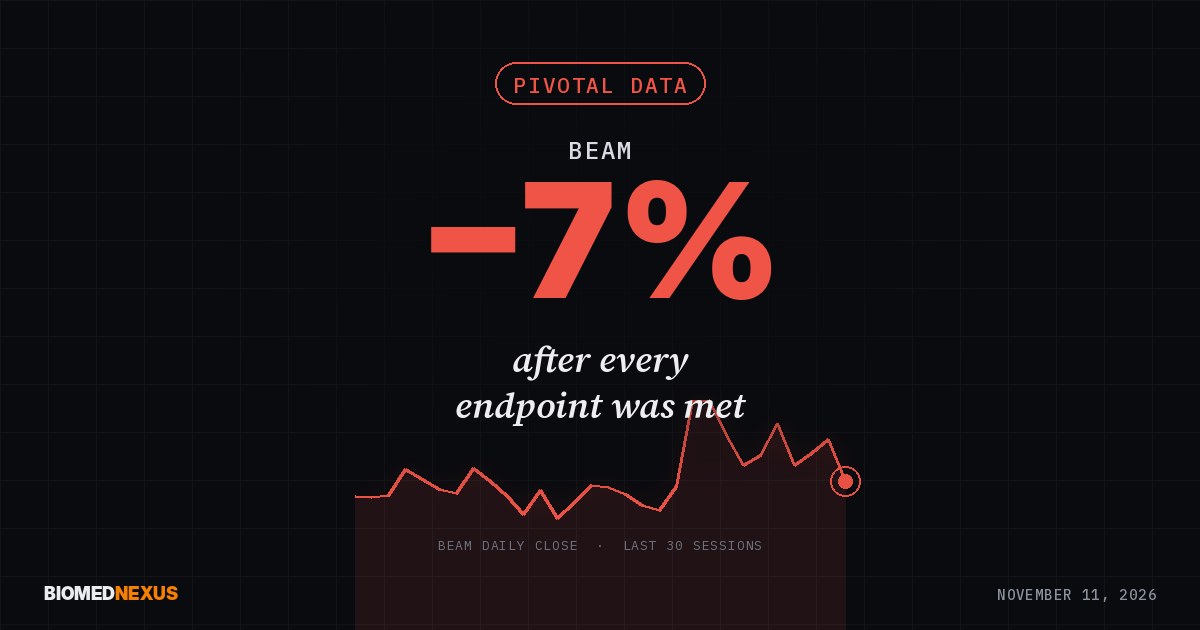
Beam’s base edited risto-cel met every endpoint in the pivotal BEACON sickle cell trial on November 10, 2026, but the stock fell 6.9% with key figures withheld.
Last updated: November 11, 2026
Beam Therapeutics said risto-cel met its primary efficacy endpoint and all safety and secondary endpoints at the prespecified interim analysis of the pivotal BEACON study in sickle cell disease, supporting a BLA filing as early as year end 2026, potentially the first for any base editing therapy.
This page covers the pivotal BEACON result and the other developments that moved life sciences on Monday, November 9 and Tuesday, November 10, 2026: the FDA’s class wide GLP-1 NAION label change, Ionis’s Tryngolza guidance cut, survodutide’s cardiovascular safety readout, the WuXi AppTec list removal, and the day’s market movers.
 SPONSORED
65% of Genomic Alterations Missed by ctDNA in ASCO 2026 Data
1Cell.Ai’s Cell Biopsy® analyzes DNA, RNA, and protein from individual circulating tumor cells using a single 10 mL blood draw. In pancreatic cancer data from ASCO 2026, single cell CTC profiling found genomic alterations that ctDNA alone did not detect.
Source: 1Cell.Ai, company reported ASCO 2026 findings.
What did Beam’s risto-cel show in the pivotal BEACON sickle cell trial?
Risto-cel met the primary efficacy endpoint, all primary safety endpoints, and all secondary endpoints of the pivotal BEACON study at a prespecified interim analysis, per Beam Therapeutics’ November 10 press release, with results adjudicated by an independent committee.
Ristoglogene autogetemcel, which Beam shortens to risto-cel and previously called BEAM-101, is a one time, autologous, base edited CD34+ cell therapy for sickle cell disease with severe vaso occlusive crises. The patient’s own blood stem cells are collected, edited outside the body to switch on fetal hemoglobin production, and returned after myeloablative busulfan conditioning. The primary efficacy endpoint, VF12, is freedom from severe vaso occlusive crises for at least 12 consecutive months. Secondary endpoints met include freedom from inpatient hospitalization for severe crises over the same window.
As of the October 20, 2026 data cutoff, 39 adults and 10 adolescents had been treated, and 31 patients had completed the follow up required for the VF12 endpoint. Beam said safety was consistent with previously reported data and with the known effects of plerixafor mobilization, cell collection, busulfan conditioning, autologous transplant, and the underlying disease. CEO John Evans said the company is “focused on submitting our planned BLA as early as year end, which has the potential to be the first BLA for a base editing therapy.” Full pivotal data are planned for a medical meeting in 2027, with an oral presentation at the ASH annual meeting on December 12 to 15 in New Orleans using an earlier cutoff.
What did Beam not disclose, and how did the market react?
The release did not say what proportion of the 31 evaluable patients met the VF12 endpoint, and it published no safety tables. The stock closed at $25.15 on November 10, down 6.9% from Monday’s close, our arithmetic from exchange settled prices.
H.C. Wainwright noted the same morning, per BioSpace, that Beam disclosed neither safety details nor the proportion of patients hitting the primary endpoint, writing that “the topline data establishes endpoint success, while detailed safety, response rates and longer-term outcomes remain the next focus.” The firm’s stated benchmark for the December ASH presentation is fetal hemoglobin induction above 60% and sickle hemoglobin below 40%, an analyst bar rather than a company target. BEACON’s one death, disclosed in November 2024 and deemed by Beam unrelated to risto-cel and likely tied to busulfan conditioning, remains part of the program’s record.
| What BEACON disclosed | Status |
|---|---|
| Primary efficacy endpoint (VF12, independently adjudicated) | Met at the prespecified interim analysis |
| Primary safety endpoints | All met |
| Secondary endpoints | All met, including freedom from VOC hospitalization |
| Patients treated | 49 (39 adults, 10 adolescents) as of October 20, 2026 |
| Patients completing the VF12 window | 31 |
| Share of patients meeting the endpoint | Not disclosed |
| Safety tables | Not disclosed (“consistent with previously reported data”) |
| US filing plan | BLA as early as year end 2026; full data at a 2027 medical meeting |
CRISPR Therapeutics, whose exa-cel therapy Casgevy is the approved gene edited treatment in the same disease, fell 9.8% to $45.15 in the same session. We found no company disclosure behind the move in Tuesday night searches; Beam’s rival data landed the same day, and we note the two facts without assigning a cause.
What NAION warning did the FDA add to GLP-1 drug labels?
In a Drug Safety Communication dated November 9, 2026, the FDA said it is requiring application holders for all GLP-1 receptor agonist medications to add information about a potential increased risk of non arteritic anterior ischemic optic neuropathy, or NAION, to the Warnings and Precautions section of labeling. It is not a boxed warning.
NAION is a rare condition in which reduced blood flow damages the optic nerve, typically causing sudden, painless vision loss in one eye. The FDA’s covered product table spans the whole class: generic exenatide (the Byetta brand application was voluntarily withdrawn in 2025), Victoza, Trulicity, Saxenda, Xultophy, Soliqua, Ozempic, Rybelsus, Wegovy, Mounjaro, Zepbound, and Foundayo, the oral orforglipron approved in 2026. Semaglutide products are Novo Nordisk’s; tirzepatide and orforglipron products are Eli Lilly’s.
The agency concluded “there is a potential increased risk of rare NAION events in patients taking GLP-1 RAs,” and its recommendations to clinicians are to instruct patients to immediately report sudden onset of acute, painless decreased vision, visual field deficits, or other visual disturbances in one eye; to refer suspected cases promptly to an ophthalmologist; and to consider discontinuing the drug in patients who develop NAION unless the benefits of treatment clearly outweigh the risk. The FDA notes that an event in one eye raises the risk in the fellow eye, and names smoking, diabetes, high blood pressure, sleep apnea, anemia and kidney disease as risk factors for the condition.
How strong is the evidence linking GLP-1 drugs to NAION?
The FDA’s own data describe a small, uncertain signal. The agency’s word throughout the communication is “potential,” and one of its two main analyses did not reach statistical significance.
| FDA cited analysis | Result |
|---|---|
| Meta analysis of 126 randomized trials (134,253 patients; 288,879 person years) | 15 probable NAION events: 10 on GLP-1 drugs, 5 on placebo, 0 on other glucose lowering drugs; incidence 6.4 vs 3.8 per 100,000 person years |
| Sentinel cohort, GLP-1 vs DPP-4 inhibitor initiators (2019 to 2024) | Hazard ratio 1.43 (95% CI 1.02 to 2.01), described by the FDA as an increased risk |
| Sentinel cohort, GLP-1 vs SGLT-2 inhibitor initiators | Hazard ratio 1.19 (95% CI 0.91 to 1.54), no statistically significant increase |
| Background rate, adults over 50 | 2.3 to 10.2 cases per 100,000 persons per year |
The review traces to a July 2024 JAMA Ophthalmology study by Hathaway and colleagues on semaglutide, which the FDA says had several limitations but warranted further assessment; animal data identified no mechanism. Europe is narrower so far: EMA’s safety committee concluded in June 2025 that NAION is a very rare side effect of semaglutide specifically, affecting up to 1 in 10,000 users, per Ophthalmology Times. We found no statement from Novo Nordisk or Eli Lilly by Tuesday night. In Tuesday trading, Eli Lilly rose 1.4% to $1,432.29 and Novo Nordisk’s US shares fell 1.6% to $40.70; the communication had been public since Monday, and we assign no cause to either move.
Why did Ionis cut Tryngolza guidance, and why did the stock fall 28.5% in two sessions?
In its third quarter results on November 9, Ionis cut 2026 Tryngolza product sales guidance to approximately $50 million from $100 to 110 million, citing “a more gradual launch ramp than anticipated as Ionis establishes a new treatment paradigm for people with sHTG.” Every other guidance line was reaffirmed.
The quarter itself beat on the top line: total revenue of $243 million rose 55% from $157 million a year earlier, with nine month revenue of $757 million. Tryngolza, the olezarsen brand approved first for familial chylomicronemia syndrome and now launching in the much larger severe hypertriglyceridemia population, booked $9 million in US net product sales in the quarter. Dawnzera, the hereditary angioedema launch, posted $37 million and kept its $110 to 120 million guidance. CEO Brett Monia said initial sales progress “has been more gradual than anticipated” while calling the underlying launch fundamentals encouraging.
| Ionis 2026 guidance line | Status after November 9 |
|---|---|
| Tryngolza product sales | Cut to approximately $50 million from $100 to 110 million |
| Dawnzera product sales | Unchanged at $110 to 120 million |
| Total revenue | Unchanged at $875 to 900 million |
| Non GAAP operating loss | Unchanged at $425 to 475 million |
| Year end cash | Unchanged at more than $1.6 billion |
The market repriced the launch story rather than the quarter: Ionis fell 21.4% on Monday to $31.00 and another 9.1% on Tuesday to $28.19, a two session decline of 28.5%, our arithmetic from settled closes. The same release carried a pipeline quarter most companies would lead with: sefaxersen reduced proteinuria 43.1% versus placebo at week 37 in Phase 3 IgAN data presented at ASN, ulefnersen met its Phase 3 primary endpoint in FUS-ALS at p=0.0005, Tryngolza received a positive CHMP opinion in sHTG with an EC decision expected in the fourth quarter, and partnered WAINUA’s CARDIO-TTRansform study missed its primary composite endpoint overall while showing nominal significance in the prespecified monotherapy population.
Did survodutide pass its cardiovascular safety trial?
Yes. Boehringer Ingelheim and Zealand Pharma said November 9 that survodutide, their glucagon/GLP-1 dual agonist, did not increase the risk of major cardiovascular events versus placebo in the Phase 3 SYNCHRONIZE-CVOT trial, meeting the primary endpoint with a non inferior result, per the companies and BioSpace.
The trial enrolled 5,530 adults with overweight or obesity who had cardiovascular disease, chronic kidney disease, or at least two weight related complications or risk factors. The primary endpoint was time to first occurrence of major cardiovascular safety events, including heart attack, stroke, cardiovascular death and heart failure events. Results were presented at the American Heart Association Scientific Sessions and published in The Lancet. Among 27 secondary endpoints, survodutide reduced systolic blood pressure and waist circumference versus placebo at week 72, and no arrhythmias were reported. Boehringer’s release headline calls survodutide the first glucagon/GLP-1 dual agonist to demonstrate a favorable cardiovascular safety profile in a global Phase 3 trial. The hazard ratio and confidence interval were not in the coverage we could retrieve, so we are not reporting them.
The tolerability trade stays in view: gastrointestinal side effects led to discontinuation in 19.3% of low dose and 20.8% of high dose patients versus 1.9% on placebo, per BioSpace, which quoted William Blair calling tolerability a significant liability and noting the trial was not designed to show cardiovascular superiority. Zealand said most discontinuations occurred during dose escalation and that ongoing studies use more flexible titration. This readout resolves the survodutide cardiovascular outcomes catalyst our calendar had carried for the end of 2026.
Why was WuXi AppTec removed from the Pentagon list, and what is BIO proposing?
The Pentagon removed WuXi AppTec from its 1260H list of Chinese military companies on Monday, November 9, per STAT and Endpoints News, and WuXi’s Hong Kong and Shanghai listed shares rose on the news, per Nikkei Asia and the South China Morning Post. We could not retrieve the updated list document itself, so the removal is reported on those outlets’ accounts.
The designation had been a central exhibit in Congress’s BIOSECURE push against Chinese contract research and manufacturing firms, and its removal takes one of the longest running overhangs off the cross border CDMO trade. A day later, the Biotechnology Innovation Organization rolled out BioAdvance, a seven pillar policy plan to keep the United States ahead of China in biotechnology, per BioSpace. Measures named in coverage include a White House Office of Biotechnology modeled on the national AI initiative office, faster first in human research and alternatives to animal testing, streamlined institutional review boards and site activation, and a resilient domestic manufacturing network as an alternative to Chinese CDMOs. BIO CEO John Crowley said, “If China becomes the world’s biotech leader, it could threaten our national security, cost countless jobs, and leave us dependent on an adversary for life-saving medicines,” with the plan declaring the biotechnology race “this generation’s space race.” Both items land days before China’s own draft biotech export control catalogue closes its comment window on November 15.
What else moved in life sciences on November 10, 2026?
PepGen reported Phase 2 FREEDOM2-DM1 results for PGN-EDODM1 in myotonic dystrophy type 1 and the stock closed up 90.0% at $4.54. Per the company’s release as carried by BioPharma Dive, the 10 mg/kg dose corrected an average 46.5% of measured splicing errors in six patients 13 weeks after four monthly doses, with four patients above 50%, which PepGen called the highest splicing correction reported in a multi dose DM1 study. Side effects were mild to moderate, nausea was most common, and a transient rise in urine protein after the first dose showed no cumulative kidney damage over 16 weeks. Leerink wrote that the correction exceeded figures reported for Novartis’s del-desiran and Dyne’s z-basivarsen, with the standard cross trial caveats. A US partial clinical hold still bars dosing in the United States, and higher dose results are expected in the first half of 2027.
Elsewhere: Labcorp completed its acquisition of Millennium Health, a specialty lab for prescription, over the counter and illicit drug testing, for $245 million in cash plus up to $130 million in milestones, per MedTech Dive, its fourth diagnostics deal since September. Karyopharm Therapeutics’ Nasdaq trading suspension takes effect November 11 following its Chapter 11 filing; the final session closed at $0.0174, down 56.5%. Prime Medicine priced a $125 million public offering at $3.50 per share Tuesday evening, 35.7 million new shares expected to close on or about November 12, per its release. Regeneron held its CIDEB MASH roundtable Tuesday morning and the stock closed down 0.4%; we could not retrieve the webcast commentary. Oyster Bio raised $60 million for tau targeting protein degraders, per BioPharma Dive, and Delix raised $100 million for a non hallucinogenic depression candidate, per BioSpace. The FDA opened a public comment docket on telesurgery and autonomous robotics, per MedTech Dive.
Which stocks moved on November 10, 2026?
Settled closes, with moves computed against Monday’s closes, our arithmetic. The broader tape was quiet: XBI fell 1.2% to $155.06 and SPY fell 0.4% to $749.92, which makes the single stock moves below stand out further.
| Ticker | Nov 10 close | Move | Context |
|---|---|---|---|
| PEPG | $4.54 | +90.0% | FREEDOM2-DM1 splicing correction data |
| BEAM | $25.15 | −6.9% | Pivotal BEACON success with response rate withheld |
| CRSP | $45.15 | −9.8% | No company disclosure found; rival pivotal data same session |
| IONS | $28.19 | −9.1% | Second session after the Tryngolza guidance cut; −28.5% in two days |
| KPTI | $0.0174 | −56.5% | Final session before the November 11 Nasdaq suspension |
| NVCR | $11.81 | −5.7% | Second session after the Optune Mya Not Approvable Letter |
Frequently asked questions
What is risto-cel?
Risto-cel, or ristoglogene autogetemcel, formerly BEAM-101, is Beam Therapeutics’ one time autologous cell therapy for severe sickle cell disease. The patient’s own blood stem cells are base edited to reactivate fetal hemoglobin and returned after busulfan conditioning.
What endpoints did the BEACON trial meet?
Per Beam’s November 10, 2026 release, the trial met its primary efficacy endpoint, VF12, freedom from severe vaso occlusive crises for at least 12 consecutive months, plus all primary safety endpoints and all secondary endpoints, at a prespecified interim analysis with independent adjudication.
How many patients has BEACON treated?
As of the October 20, 2026 cutoff, 49 patients had been treated, 39 adults and 10 adolescents, and 31 had completed the follow up required for the primary endpoint.
Why did Beam’s stock fall after positive pivotal data?
The release did not disclose the share of patients meeting the endpoint or any safety figures, and analysts flagged that gap. The stock closed down 6.9% at $25.15 on November 10. Detailed data come at the ASH meeting in December and a medical meeting in 2027.
When will Beam file for FDA approval of risto-cel?
Beam plans to submit a BLA as early as the end of 2026. If completed on that schedule, it would be the first US license application for a base editing therapy.
How does risto-cel differ from Casgevy?
Both are autologous ex vivo edited stem cell therapies for sickle cell disease that use busulfan conditioning. Casgevy, from Vertex and CRISPR Therapeutics, uses CRISPR nuclease editing that cuts DNA; risto-cel uses base editing, which changes single DNA letters without a double strand break. Comparative performance has not been established in any head to head trial.
What is NAION?
Non arteritic anterior ischemic optic neuropathy is a rare condition in which reduced blood flow damages the front of the optic nerve, typically causing sudden, painless vision loss in one eye. In adults over 50 the background rate is 2.3 to 10.2 cases per 100,000 persons per year, per the FDA.
Which GLP-1 drugs must add the NAION warning?
All of them. The FDA’s November 9, 2026 Drug Safety Communication covers generic exenatide, Victoza, Saxenda, Xultophy, Trulicity, Soliqua, Ozempic, Rybelsus, Wegovy, Mounjaro, Zepbound and Foundayo, with the new language going into the Warnings and Precautions section of each label.
How common is NAION in people taking GLP-1 drugs?
Rare. Across 126 randomized trials the FDA counted 15 probable events among 134,253 patients, about 6.4 per 100,000 person years on the drugs versus 3.8 on comparators. Its claims based analysis found a significant increase only against DPP-4 inhibitors, not against SGLT-2 inhibitors.
Should patients stop taking GLP-1 drugs because of the warning?
The FDA does not say that. It advises patients to seek care immediately for sudden painless vision loss in one eye and advises clinicians to consider discontinuing only in patients who develop NAION, unless the benefits of treatment clearly outweigh the risk. Patients should raise questions with their own clinician. This article is information, not medical advice.
Why did Ionis stock fall more than 28% in two sessions?
Ionis cut its 2026 guidance for Tryngolza, its severe hypertriglyceridemia launch, to approximately $50 million from $100 to 110 million on November 9, citing a more gradual ramp. The stock fell 21.4% Monday and 9.1% Tuesday even though total revenue guidance was reaffirmed and third quarter revenue rose 55%.
What did survodutide’s cardiovascular trial show?
SYNCHRONIZE-CVOT, in 5,530 adults, met its primary endpoint: survodutide did not increase major cardiovascular events versus placebo, a non inferior result presented at the American Heart Association meeting and published in The Lancet. GI driven discontinuations ran about 19 to 21% versus 1.9% on placebo, per BioSpace.
Why was WuXi AppTec removed from the Pentagon’s list?
The Defense Department removed WuXi AppTec from its 1260H Chinese military companies list on November 9, per STAT and Endpoints. The outlets’ reporting notes the company had contested the designation; we could not retrieve the updated list document, so details are attributed.
What results did PepGen report in myotonic dystrophy?
PepGen said PGN-EDODM1 at 10 mg/kg corrected an average 46.5% of measured splicing errors in six patients in its Phase 2 FREEDOM2-DM1 study, with mild to moderate side effects, per its release as carried by BioPharma Dive. A US partial clinical hold still bars dosing in the United States, and higher dose data are expected in the first half of 2027.
Sources
Primary sources: Beam Therapeutics press release, “Beam Therapeutics Announces Positive Topline Pivotal Data from BEACON,” November 10, 2026 (investors.beamtx.com). FDA Drug Safety Communication, “FDA requires safety labeling changes for GLP-1 receptor agonists due to potential increased risk of NAION,” November 9, 2026 (fda.gov). Ionis Pharmaceuticals third quarter 2026 results release, November 9, 2026 (ir.ionis.com). Prime Medicine offering pricing release, November 10, 2026. FDA press announcement listing, November 9, 2026 (factor XIa inhibitor approval).
Trade and market coverage (attributed in text): BioSpace, November 9 and 10, 2026 (Beam analyst reaction; survodutide SYNCHRONIZE-CVOT; BIO BioAdvance plan; Delix financing). BioPharma Dive, November 10, 2026 (PepGen FREEDOM2-DM1; Oyster financing). MedTech Dive, November 9 and 10, 2026 (Labcorp and Millennium Health; FDA telesurgery docket). STAT and Endpoints News, November 9, 2026 (WuXi AppTec list removal). Ophthalmology Times and Pharmacy Times, November 9, 2026 (NAION communication detail; EMA PRAC context). Fierce Pharma (Summit ivonescimab survival update and review timing context). Nikkei Asia and South China Morning Post (WuXi share reaction).
Market data: Exchange settled closing prices for November 9 and 10, 2026; percentage moves are our arithmetic.