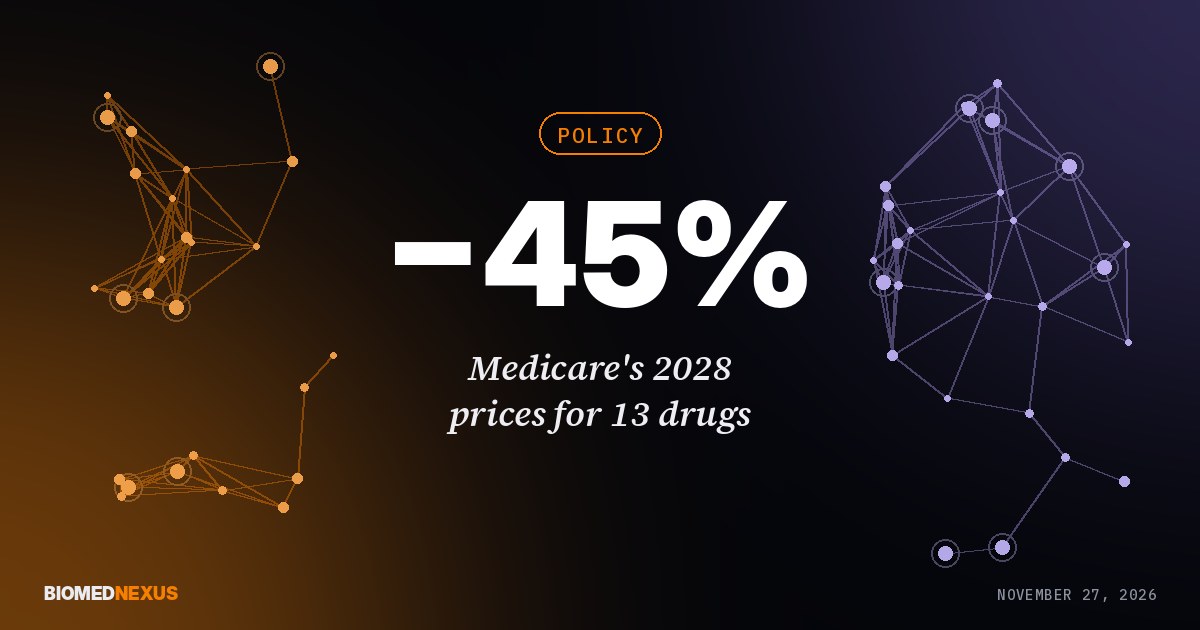
CMS set 2028 Medicare negotiated prices for 13 drugs on November 23, 2026, an estimated 45 percent net cut led by an 84 percent reduction for Trulicity.
Last updated: November 27, 2026
CMS published maximum fair prices for 13 Part B and Part D drugs, effective January 1, 2028. The agency estimates net savings of 45 percent, or $9.2 billion, against 2025 spending, with individual discounts running from 34 to 84 percent.
This page covers the third negotiation cycle in full, plus the rest of the Wednesday, November 25 session: Kymera’s $2.013 billion closing, PolyPid’s first approval, Pharming’s Ruconest pause, and Amgen’s Opdivo biosimilar settlement. US markets are closed Thursday for Thanksgiving and run a shortened session Friday, November 27, which is also the FDA’s target action date for BridgeBio’s BBP-418 in limb girdle muscular dystrophy type 2I/R9; an approval would make it the first therapy approved for any form of the disease.
How much will Medicare save on the 2028 negotiated prices?
CMS estimates net savings of 45 percent, or $9.2 billion, measured against 2025 spending on the 13 drugs. Excluding Part D Manufacturer Discount Program spending, the saving is about $5.5 billion, or 33 percent. The prices take effect January 1, 2028.
The announcement, dated November 23 and picked up by trade press through November 25, closes the third negotiation cycle under the Inflation Reduction Act. The negotiation period ended November 1, 2026. Counting the 10 drugs priced for 2026 and the 15 priced for 2027, CMS puts the program at 37 negotiated drugs, with Tradjenta the first renegotiation. The 13 drugs carried about $22.3 billion in 2025 gross Part D costs, roughly 6 percent of that program, plus $3.3 billion in Part B, roughly 2 percent. CMS projects 2028 out of pocket savings of $69 million in Part D and $395 million in Part B, modest numbers next to the headline figure because the redesigned Part D benefit already caps patient costs. CMS Administrator Mehmet Oz framed the announcement around seniors who “leave the pharmacy empty handed because they can’t afford their medication.”
Which 13 drugs received 2028 maximum fair prices?
Trulicity took the deepest cut at 84 percent, followed by the renegotiated Tradjenta at 83 percent and Anoro Ellipta at 72 percent. Biologics with defended franchises, including Entyvio, Biktarvy and Cimzia, settled between 34 and 37 percent below 2025 costs.
| Drug | Company | 2028 price, 30 days | 2025 cost, 30 days | Change |
|---|---|---|---|---|
| Trulicity | Eli Lilly | $150 | $965 | −84% |
| Tradjenta (renegotiated) | Boehringer Ingelheim | $81 | $469 | −83% |
| Anoro Ellipta | GSK | $130 | $465 | −72% |
| Cosentyx | Novartis | $2,600 | $7,835 | −67% |
| Orencia | Bristol Myers Squibb | $1,750 | $4,052 | −57% |
| Erleada | Janssen Biotech | $7,004 | $14,253 | −51% |
| Lenvima | Eisai | $12,985 | $23,878 | −46% |
| Verzenio | Eli Lilly | $8,650 | $15,423 | −44% |
| Kisqali | Novartis | $8,650 | $15,120 | −43% |
| Rexulti | Otsuka | $780 | $1,320 | −41% |
| Biktarvy | Gilead Sciences | $2,600 | $4,141 | −37% |
| Cimzia | UCB | $1,375 | $2,195 | −37% |
| Entyvio | Takeda | $2,645 | $4,035 | −34% |
Prices and discounts are from the CMS fact sheet, which lists each drug’s negotiated 30 day price against its 2025 gross cost per 30 day supply. The pattern worth noting: the deepest cuts landed on small molecules at or past their patent cliffs, while biologics with ongoing exclusivity kept the largest share of their price. BioPharma Dive, citing the renegotiation detail, reports Tradjenta’s new price actually sits $3 a month above its prior negotiated price, a signal that renegotiation can floor as well as cut.
Why are Xeljanz, Xolair and Botox not on the list?
Xeljanz, Xeljanz XR and Xolair received no maximum fair price because generics or biosimilars are now marketed, which removes a drug from negotiation. Botox was excluded under a court order in AbbVie v. HHS, and that litigation is ongoing.
The exits are the program’s built in sunset: once competition arrives, CMS steps aside and lets the market set the price. Pfizer’s Xeljanz and the Roche and Novartis antibody Xolair had been selected for this cycle before falling off. The Botox carve out runs through the court order in AbbVie v. HHS, case 1:26-cv-00431 in the District of Columbia; BioPharma Dive reports the ruling turned on the law’s exemption for products containing human plasma. Dr. Reddy’s has filed for a biosimilar to Orencia, per the same report, which could eventually take a second drug off the negotiated list before its price even bites.
What did Kymera Therapeutics close on November 25?
Kymera closed its upsized underwritten public offering: 13,383,700 shares at $150.37, including 1,745,700 shares from the underwriters’ option exercised in full, for gross proceeds of about $2.013 billion before fees, up from the $1.75 billion announced at pricing.
The closing completes a 48 hour loop that started with Monday’s Phase 2b atopic dermatitis data for the oral STAT6 degrader KT-621 and Monday night’s pricing at $150.37, the exact prior close, a zero discount deal. The full option exercise means underwriters took every additional share available. Morgan Stanley, J.P. Morgan, Jefferies, TD Cowen, Goldman Sachs, Stifel and Wells Fargo ran the books. The stock closed Wednesday at $173.77, essentially flat on the day and 15.6 percent above the issue price, our arithmetic from settled closes. The same session supplied the counterexample: SELLAS Life Sciences, which priced a $150 million offering at $13.00 last week after its AML Phase 3 readout, closed at $12.74, the first finish below its issue price, with its closing release still unannounced as of Wednesday night. The window is paying for evidence and still refusing to pay twice for a story.
What did SHIELD II show for PolyPid’s Bacfenssi?
SHIELD II met its primary endpoint and all key secondaries in 798 patients with incisions longer than 20 cm. The composite of surgical site infection, mortality or reintervention fell from 18.1 percent to 10.9 percent, and the infection rate fell from 9.5 percent to 3.8 percent.
| SHIELD II endpoint | Bacfenssi plus standard of care | Standard of care | Result |
|---|---|---|---|
| Composite: SSI, all cause mortality or reintervention | 10.9% | 18.1% | 40% relative risk reduction, p=0.004 |
| Surgical site infection rate | 3.8% | 9.5% | 60% relative risk reduction, p=0.001 |
The FDA approved Bacfenssi, formerly D-PLEX100, on November 24 as the first product indicated to reduce surgical site infections in colorectal surgery, covering adults and pediatric patients of 45 kg or more with incisions longer than 20 cm; efficacy is not established for shorter incisions. The product is a doxycycline hyclate extended release paste, 63 mg per vial, applied into the surgical site at wound closure, built on PolyPid’s Kynatrix technology to release antibiotic locally for about 30 days. The 505(b)(2) application carried Priority Review plus Breakthrough Therapy, Fast Track and QIDP designations, and the release cites eight years of exclusivity, three for new clinical investigations and five under the GAIN Act. Azurity Pharmaceuticals holds exclusive US and Canada commercialization rights and plans a US launch in early 2027 across a reach the companies put at more than 1,700 hospitals; PolyPid manufactures from a single facility in Israel. A new technology add on payment application sits with CMS, with a decision expected in August 2027, and an EMA decision is expected in the second half of 2027. The market’s verdict was cold: PYPD closed Wednesday, the first session after the approval, at $4.56, down 17.5 percent, our arithmetic. We found no offering, no dilution event and no other company disclosure behind the move in Wednesday night searches; the filings that surfaced were November 2025 vintage and irrelevant.
Why did Pharming pause Ruconest manufacturing?
Pharming’s third party fill finish manufacturer failed a routine simulation of the aseptic manufacturing process, a media fill, and paused production. Pharming notified the FDA of a likely supply interruption and says current US supply is available through mid December.
Ruconest, a recombinant C1 esterase inhibitor for acute hereditary angioedema attacks, is Pharming’s main product, and the November 25 release, flagged as inside information under EU market abuse rules, does not name the contract manufacturer. Product already at specialty pharmacies or with patients can be used as directed, and the company is working with providers, specialty pharmacies and the Hereditary Angioedema Association on continuity plans while encouraging patients to review their HAE action plans. Manufacturing does not restart until the root cause is identified, resolved and the process requalified, and Pharming says timeline and impact are to be confirmed; no other Pharming medicine is affected. The US listed shares closed at $10.09, down 23.7 percent, our arithmetic. For operators the mechanism matters more than the stock: one failed media fill at one outsourced line put a three week clock on US availability of an acute rescue therapy.
When will Amgen’s Opdivo biosimilar launch in the United States?
October 1, 2028, under a settlement with Bristol Myers Squibb, E.R. Squibb and Ono Pharmaceutical that resolves US patent litigation over ABP 206, subject to FDA approval. The companies announced the agreement this week; financial terms were not disclosed.
The date comes from Amgen’s announcement as reported November 25 by PharmaShots, BioPharma Dive and other outlets; we could not retrieve the release itself, so treat the detail as attributed to the companies. ABP 206, a PD-1 antibody referencing Opdivo, has a BLA under FDA review with a decision expected by the end of 2026. The settlement converts years of litigation risk into a calendar entry and gives the market its first firm date for US biosimilar competition against one of oncology’s largest franchises. It also closes our standing watch on when that entry estimate would harden.
What else crossed in the holiday week session?
Eli Lilly’s LoQus23 acquisition, two rare FDA transparency citations and a fully briefed 340B motion rounded out the tape heading into Thanksgiving.
Eli Lilly agreed to acquire LoQus23 Therapeutics of Cambridge, England for up to $725 million in cash, an upfront payment plus development and regulatory milestones, with the split undisclosed, per the November 23 release. The lead program, LQT-23, is a selective oral allosteric inhibitor of MSH3, part of the MutSβ complex, designed to block the somatic expansion of triplet repeats that drives Huntington’s disease progression; it is preclinical, with a clinical trial application anticipated by the end of 2026 and possible extension into myotonic dystrophy type 1. BioSpace counts the deal as Lilly’s fifteenth acquisition of 2026. Separately, press reports say the FDA issued rare noncompliance notices to Duchesnay and Addex Pharma for failing to post clinical trial results to ClinicalTrials.gov, with one notice covering a Diclegis study in pregnant teenagers; the notices themselves were not retrievable by our fetch, so the item stands as attributed. And in the 340B rebate pilot litigation over the program set to launch January 1, 2027, the preliminary injunction motion became fully briefed on November 16, per the Georgetown Law litigation tracker, leaving the decision with Judge Lance Walker in the District of Maine as the launch date approaches.
Which stocks moved on November 25, 2026?
The selloffs were company specific and the sector was flat: XBI slipped 0.2 percent and SPY 0.3 percent into the holiday. Closes are Wednesday’s settled prints; percentages are our arithmetic.
| Ticker | Close | Move | Context |
|---|---|---|---|
| PHAR (US listed) | $10.09 | −23.7% | Ruconest manufacturing pause, US supply through mid December |
| PYPD | $4.56 | −17.5% | First session after the Bacfenssi approval; no new disclosure found |
| COGT | $36.10 | +9.4% | Second session after the Ekitna approval; two day move +28.4% |
| SNY (ADR) | $54.35 | +4.7% | Second session after the Insmed deal; two day move +16.2% |
| KYMR | $173.77 | −0.1% | Held 15.6% above the $150.37 issue as the $2.013B offering closed |
| SLS | $12.74 | −3.8% | First close below the $13.00 issue price; closing release still absent |
Frequently asked questions
What are Medicare maximum fair prices?
Maximum fair prices are the ceilings Medicare will pay for selected high cost drugs under the Inflation Reduction Act’s negotiation program. CMS negotiates them with manufacturers on a set statutory schedule, and the 2028 set is the program’s third cycle.
When do the 2028 negotiated prices take effect?
January 1, 2028. CMS announced the prices on November 23, 2026, after a negotiation period that ended November 1, 2026.
Which drug received the largest 2028 price cut?
Eli Lilly’s Trulicity, priced at $150 for a 30 day supply against a 2025 gross cost of $965, an 84 percent reduction. The renegotiated Tradjenta follows at 83 percent.
How much will the 2028 prices save Medicare?
CMS estimates net savings of 45 percent, or $9.2 billion, against 2025 spending on the 13 drugs. Excluding Part D Manufacturer Discount Program spending, the estimate is about $5.5 billion, or 33 percent.
Why was Botox excluded from Medicare negotiation?
A federal court order in AbbVie v. HHS bars CMS from treating Botox and Botox Cosmetic as selected drugs while the litigation continues. BioPharma Dive reports the ruling rests on the law’s exemption for products containing human plasma.
What happens when a negotiated drug faces a generic or biosimilar?
It leaves the program. Xeljanz, Xeljanz XR and Xolair received no 2028 maximum fair price because generics or biosimilars are now marketed, so market competition replaces the negotiated ceiling.
How many drugs has Medicare negotiated so far?
CMS counts 37 across three cycles: 10 drugs with prices effective 2026, 15 effective 2027 and 13 effective 2028, with Tradjenta renegotiated in the latest round.
What is Bacfenssi and who sells it?
Bacfenssi, formerly D-PLEX100, is PolyPid’s doxycycline hyclate extended release paste applied inside the surgical wound at closure to release antibiotic locally for about 30 days. Azurity Pharmaceuticals holds exclusive US and Canada commercialization rights, with a US launch planned for early 2027.
What did the SHIELD II trial show?
In 798 colorectal surgery patients with incisions longer than 20 cm, adding Bacfenssi to standard care cut the composite of infection, death or reintervention to 10.9 percent from 18.1 percent, and the infection rate to 3.8 percent from 9.5 percent.
Who can receive Bacfenssi under the approved label?
Adults and pediatric patients weighing at least 45 kg undergoing colorectal surgery with incisions longer than 20 cm. The label notes efficacy has not been established for incisions of 20 cm or less.
Why did Pharming stop making Ruconest?
Its third party fill finish manufacturer failed a media fill, a routine simulation of the aseptic manufacturing process, and production is paused until the root cause is resolved and the process requalified. Pharming notified the FDA of a likely supply interruption.
How long will US Ruconest supply last?
Pharming says current supply is available through mid December 2026, and product already at pharmacies or with patients can be used as directed.
When will a biosimilar of Opdivo launch in the United States?
October 1, 2028, under Amgen’s settlement with Bristol Myers Squibb and Ono covering ABP 206, subject to FDA approval. The FDA is expected to decide on the ABP 206 application by the end of 2026, per the companies’ announcement.
What did Eli Lilly pay for LoQus23?
Up to $725 million in cash, structured as an undisclosed upfront payment plus development and regulatory milestones, for the preclinical MSH3 inhibitor LQT-23 in Huntington’s disease.
Sources
Primary sources:
- CMS press release: lower negotiated prices for 13 high cost drugs (November 23, 2026)
- CMS fact sheet: negotiated prices for initial price applicability year 2028 (November 2026)
- Kymera Therapeutics closing release (November 25, 2026, GlobeNewswire carry)
- PolyPid release: FDA approval of Bacfenssi (November 24, 2026)
- Pharming release: Ruconest manufacturing pause (November 25, 2026)
- LoQus23 release: acquisition by Eli Lilly (November 23, 2026)
- BridgeBio release: FDA acceptance and Priority Review of the BBP-418 NDA, PDUFA November 27, 2026 (May 27, 2026)
Additional reporting:
- Healthcare Dive and BioPharma Dive: Medicare sets 2028 prices for 13 drugs (November 25, 2026)
- PharmaShots: Amgen settlement with BMS and Ono on ABP 206 (November 25, 2026)
- Georgetown Law litigation tracker: AHA v. Kennedy, 340B rebate pilot (updated November 19, 2026)
- Medical Daily: FDA cites Duchesnay and Addex over unposted trial results (November 25, 2026)