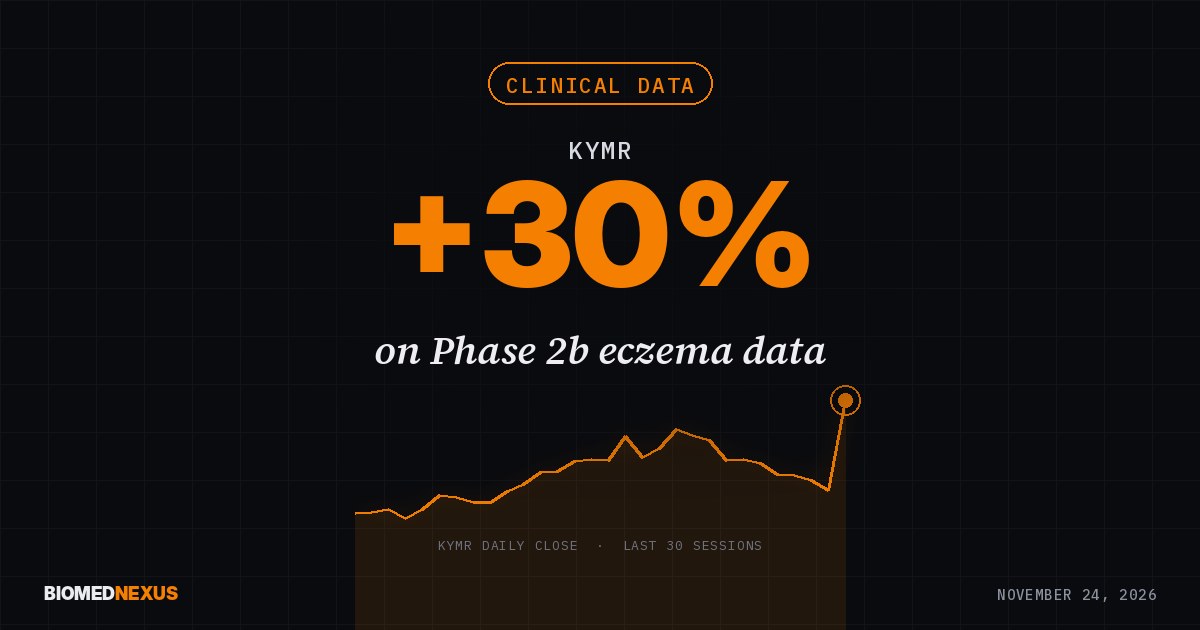
Kymera’s oral STAT6 degrader KT-621 cleared Phase 2b in atopic dermatitis, and the company priced a $1.75 billion offering the same day, November 23, 2026.
Last updated: November 24, 2026
Kymera’s KT-621 beat placebo on every reported endpoint in the 244 patient BROADEN2 trial, with a 72 percent EASI reduction at the mid dose. That evening, Kymera priced an upsized $1.75 billion stock offering at $150.37, exactly Monday’s closing price.
This page covers the BROADEN2 results and the offering terms, Capricor’s first trading session after its second complete response letter, what Invivyd’s DECLARATION interim actually showed, and Lilly’s acquisition of LoQus23, with Monday’s settled closes.
What did Kymera’s KT-621 show in the BROADEN2 Phase 2b trial?
KT-621, a once daily oral STAT6 degrader, met the primary endpoint at all three doses in moderate to severe atopic dermatitis. The mid dose cut EASI scores 72 percent from baseline at Week 16 versus 27 percent for placebo, with every reported secondary endpoint also hitting.
BROADEN2 randomized 244 adults and adolescents 1:1:1:1 to three dose levels or placebo for 16 weeks. Patients entered with a mean EASI of about 28 and a mean peak pruritus score of 7.1, and a third had already been on a biologic. The company reported the data before Monday’s open; the figures below are from the release.
| Endpoint, Week 16 | Mid dose | Placebo | p value |
|---|---|---|---|
| EASI change from baseline | 72% | 27% | p<0.0001 |
| EASI-75 response | 62% | 22% | p<0.0001 |
| EASI-90 response | 43% | 10% | p<0.0001 |
| vIGA-AD clear or almost clear | 38% | 11% | p=0.0008 |
| Itch improvement of 4 points or more | 52% | 13% | p<0.0001 |
The low dose cut EASI 64 percent and the high dose 61 percent, both significant against placebo. The release says improvement separated from placebo as early as Week 1 and that the mid dose was numerically best across endpoints. Of 244 randomized patients, 234 completed the double blind period and 230 entered a 52 week open label extension.
Safety is the part the field will study. The release describes the drug as well tolerated, with no dose dependent adverse event pattern and only one imbalance against placebo: conjunctivitis, pooled across all terms, at 19.7 percent on the low dose, 13.1 percent on the mid dose and 11.1 percent on the high dose, all mild to moderate, with no discontinuations. Four serious adverse events occurred across the trial, all judged unrelated to study drug. Conjunctivitis is a familiar signature of IL-4 and IL-13 pathway blockade, so a rate that does not rise with dose will get attention when the full data are presented.
Kymera says the data support dose selection for parallel registrational programs across dermatology, gastroenterology and respiratory indications, with the first Phase 3 atopic dermatitis trial to start by mid 2027, subject to alignment with regulators, and the BREADTH Phase 2b asthma readout expected in late 2027. The company’s comparison to dupilumab is a cross study claim, not a head to head result, and the release itself cautions that such comparisons may not be reliable. Wall Street analysts nonetheless called the efficacy biologic like, and Leerink’s Thomas Smith wrote that the data are strongly supportive of an effective oral option, per BioPharma Dive.
How big was Kymera’s offering and on what terms?
Kymera priced an upsized underwritten public offering of 11,638,000 shares at $150.37 for gross proceeds of approximately $1.75 billion, before underwriting discounts. The offer price equals Monday’s settled close to the penny, meaning the deal priced at no discount to the market.
| Term | Detail |
|---|---|
| Shares | 11,638,000, all sold by Kymera |
| Price | $150.37 per share, equal to Monday’s close |
| Gross proceeds | Approximately $1.75 billion (release figure) |
| Overallotment option | 1,745,700 additional shares, 30 days |
| Expected close | November 25, 2026 |
| Bookrunners | Morgan Stanley, J.P. Morgan, Jefferies, TD Cowen, Goldman Sachs, Stifel, Wells Fargo |
The sequence matters as much as the size. The data crossed at 7:00 am Eastern, KYMR closed up 30.4 percent at $150.37 on volume several times its recent average, the proposed offering was announced at 4:45 pm, and the upsized deal priced at 9:50 pm the same night, off the company’s existing shelf. Use of proceeds is the degrader pipeline plus general corporate purposes. The multiplication of shares and price is our arithmetic; both components are from the pricing release.
What happened to Capricor stock after the second deramiocel CRL?
CAPR fell 74.7 percent to $1.92 in its first session after Friday evening’s second complete response letter and the FDA’s public statement on HOPE-3 data integrity. The company says it is weighing all options, including a Type A meeting and an appeal, per Pink Sheet.
Friday’s rejection came with an unusual public statement from the FDA’s biologics center describing serious conduct deficiencies in the HOPE-3 trial, language Capricor disputes. On Monday’s call, CEO Linda Marbán called the decision indefensible and said the company’s data were independently validated before the July advisory committee meeting, per Pink Sheet’s account. Capricor reported $198.5 million in cash as of September 30 with at least twelve months of runway and a cost review underway. The session was the stock’s first chance to price the letter, since the news crossed after Friday’s close.
| Date | Event |
|---|---|
| July 2025 | First complete response letter on the original BLA |
| July 29, 2026 | Advisory committee votes against deramiocel; a majority of panelists unconvinced |
| November 20, 2026 | Second CRL on the resubmitted BLA, plus a same day public FDA statement citing HOPE-3 data integrity |
| November 23, 2026 | First reaction session: CAPR closes at $1.92, down 74.7 percent; company weighs Type A meeting and appeal (per Pink Sheet) |
What did Invivyd’s DECLARATION interim analysis actually report?
Invivyd said all interim primary and secondary endpoints were met for VYD2311, but reported no observed efficacy numbers. The 70 to 90 percent protection figure is a prediction from antibody titers, not a measured result, because clinical COVID-19 events in the trial remain blinded.
The Phase 3 DECLARATION interim covered 2,359 randomized adults and adolescents assigned 1:1:1 to a single 250 mg intramuscular dose of the monoclonal antibody, monthly 250 mg doses, or saline placebo, with symptomatic RT-PCR confirmed COVID-19 over 90 days as the clinical endpoint. The release reports that mean antiviral titers were consistent with the company’s target of 70 to 90 percent expected protection in both active arms, describes safety as in line with saline placebo without giving event rates, and discloses no titer values, case counts or confidence intervals. Invivyd intends to file for accelerated approval in the first quarter of 2027 and says, based on FDA feedback, it expects review by or with input from CBER. The blinded event data are intended to support a later traditional approval.
The distinction between observed and predicted protection is the entire story here. A reader of the headline, which announces a new era for immunization, would not learn that no case counts have been unblinded. IVVD closed up 17.6 percent at $0.4854, a first reaction worth noting mostly for its restraint: the market moved a sub dollar stock, not a franchise valuation, on a release built from modeled protection.
What did Lilly buy in LoQus23, and why does MSH3 matter in Huntington’s disease?
Lilly acquired LoQus23 Therapeutics, a preclinical Cambridge, England biotech, for up to $725 million in cash, an upfront payment plus development and regulatory milestones with no split disclosed. Its lead asset LQT-23 is an oral allosteric inhibitor of MSH3, a DNA mismatch repair protein.
In Huntington’s disease, the CAG repeat tract in the huntingtin gene keeps expanding in neurons over a patient’s lifetime, and somatic expansion speed tracks disease progression. MSH3, part of the MutSβ complex, drives that expansion, so blocking it is an attempt to slow the disease upstream of the mutant protein itself, and the company says the approach may extend to other triplet repeat diseases. LoQus23 reports that LQT-23 blocked somatic expansion in cellular systems and animal models, with a clinical trial application anticipated in the near future; the release’s subhead puts that submission by the end of 2026. The company was seeded by SV Health Investors’ Dementia Discovery Fund in 2019, took a seed extension led by Novartis Venture Fund in 2021, and raised a £35 million Series A led by Forbion in October 2024. For Lilly, which BioPharma Dive counts at more than a dozen acquisitions this year, it is a genetics first neuroscience bet in the same week it slated the EMBER-3 final overall survival readout as a late breaking oral at the San Antonio Breast Cancer Symposium on December 11.
Which stocks moved on Monday, November 23?
Monday was a broad risk on session, with the S&P 500 up 4.7 percent after the prior week’s 8.6 percent slide, so single stock moves below are read against a strong tape. Settled closes, our percentages versus Friday’s closes.
| Ticker | Close, Nov 23 | Move | Context |
|---|---|---|---|
| KYMR | $150.37 | +30.4% | BROADEN2 data before the open; $1.75B offering priced at the close price that night |
| CAPR | $1.92 | −74.7% | First session after the second deramiocel CRL and FDA statement |
| IVVD | $0.4854 | +17.6% | DECLARATION interim; predicted, not observed, protection |
| INSM | $149.09 | +5.5% | Second full session of the Sanofi takeover report; no formal statements yet |
| XBI | $147.16 | +5.0% | Sector context |
| SPY | $722.29 | +4.7% | Market context, biggest bounce of the month |
Frequently asked questions
What is KT-621 and how does it work?
KT-621 is a once daily oral degrader of STAT6, the transcription factor that carries IL-4 and IL-13 signaling. Rather than blocking a receptor the way injectable biologics do, it removes the signaling node itself.
How many patients were in BROADEN2 and what did it measure?
244 adults and adolescents with moderate to severe atopic dermatitis, randomized equally to three doses or placebo for 16 weeks. The primary endpoint was percent change in EASI, a standard eczema severity index, at Week 16.
Did KT-621 match Dupixent?
There is no head to head trial. Kymera says the results support the potential for disease control at the level historically reported for approved biologics, and analysts called the profile biologic like, but cross trial comparisons are unreliable and the release says so itself.
What safety signals showed up in BROADEN2?
Conjunctivitis was the one imbalance against placebo, at 19.7, 13.1 and 11.1 percent across the low, mid and high doses, all mild to moderate with no discontinuations. Four serious adverse events were all judged unrelated to the drug.
When could KT-621 reach the market?
Kymera plans its first Phase 3 atopic dermatitis trial by mid 2027, subject to regulator alignment, which puts any approval years out. The asthma Phase 2b readout expected in late 2027 is the next major catalyst.
What are the terms of Kymera’s $1.75 billion offering?
11,638,000 shares at $150.37, equal to Monday’s close, for roughly $1.75 billion gross, with a 30 day option on 1,745,700 more shares. It is expected to close November 25, 2026.
Why does it matter that the offering priced at the closing price?
Follow on offerings usually price at a discount to the last close to clear. A zero discount print after a 30.4 percent up day means demand exceeded the deal, which is information about how institutions value observed Phase 2b data.
Why did Capricor stock fall 74.7 percent on Monday?
Monday was the first trading session after Friday evening’s second complete response letter for deramiocel and an FDA public statement describing serious data integrity problems in the HOPE-3 trial, which Capricor disputes.
What options does Capricor have after the second CRL?
Per Pink Sheet, the company is evaluating all next steps, including a Type A meeting with the FDA and an appeal. CEO Linda Marbán called the rejection indefensible and says the data were independently validated before July’s advisory committee.
Did Invivyd’s VYD2311 actually prevent COVID-19 in DECLARATION?
Unknown so far. The interim analysis met its endpoints, but those endpoints rest on antibody titers and predicted protection of 70 to 90 percent. Actual infection events in the trial remain blinded and will support a later traditional approval filing.
When will Invivyd file with the FDA?
The company anticipates a BLA seeking accelerated approval in the first quarter of 2027, and says it expects the review to run by, or with input from, CBER.
What does LoQus23’s LQT-23 do in Huntington’s disease?
It is a preclinical oral allosteric inhibitor of MSH3, a mismatch repair protein that drives somatic expansion of the CAG repeat in the huntingtin gene. Slowing that expansion is intended to slow the disease itself, a genetics driven approach distinct from huntingtin lowering.
How much is Lilly paying for LoQus23?
Up to $725 million in cash, split between an undisclosed upfront payment and development and regulatory milestones. The components were not broken out.
What is the next big readout on Lilly’s SABCS calendar?
The final overall survival analysis of EMBER-3, the Phase 3 trial of Inluriyo (imlunestrant) in ESR1 mutated advanced breast cancer, is a late breaking oral presentation on December 11, 2026.
Sources
Primary sources, November 23, 2026: Kymera Therapeutics BROADEN2 Phase 2b results release; Kymera Therapeutics pricing release for the upsized $1.75 billion public offering; Invivyd DECLARATION interim analysis release (investors.invivyd.com); LoQus23 Therapeutics acquisition release (loqus23.com); Eli Lilly SABCS 2026 presentation slate release. Prior primary sources: Capricor Therapeutics November 20, 2026 regulatory update release; FDA statement on the deramiocel BLA (fda.gov, November 20, 2026). Trade coverage, attributed where cited: Pink Sheet (Citeline) on Capricor’s November 23 comments; BioPharma Dive on the Kymera data and the Lilly LoQus23 acquisition. Market data: exchange settled closing prices via Robinhood; percentage moves are our arithmetic.