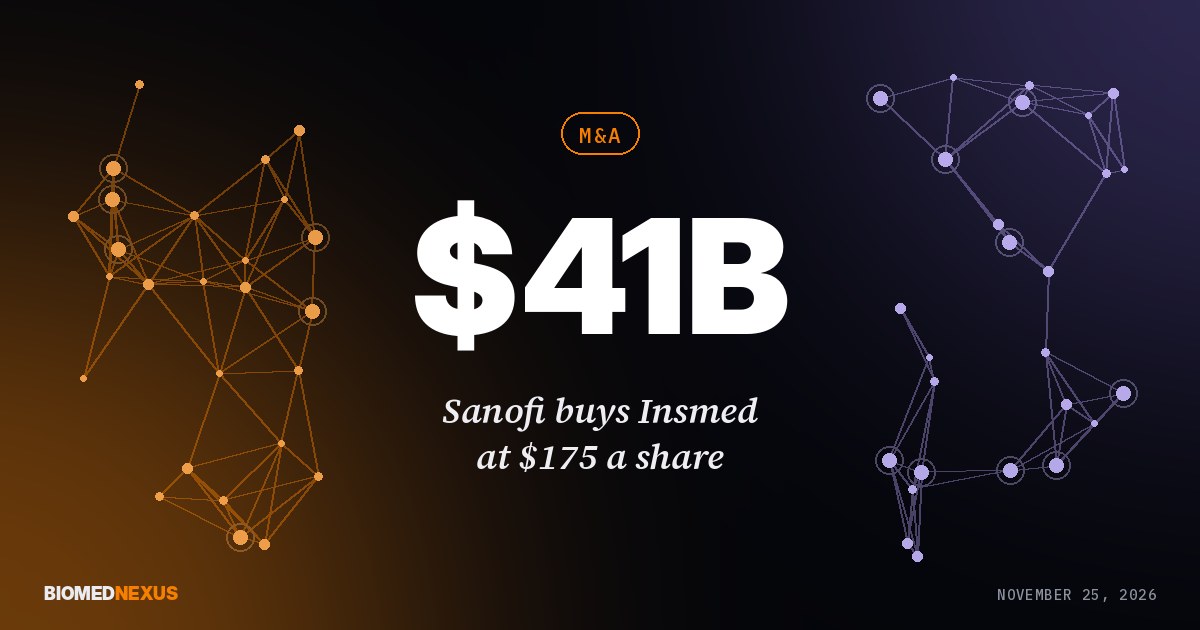
Sanofi agreed to buy Insmed for $41 billion, or $175 per share in cash, on November 24, 2026. The year’s biggest biopharma deal is expected to close in H1 2027.
Last updated: November 25, 2026
Sanofi will pay $175 per share in cash for Insmed, a total equity value of roughly $41.0 billion, the largest biopharma acquisition of 2026. Both boards approved the merger, financing is committed, and closing is expected in the first half of 2027.
This brief covers the Sanofi and Insmed merger agreement, the week’s cluster of early FDA approvals, the missed Savara action date, MiniMed’s second standalone quarter, and the session’s market reaction, with primary sources throughout.
How much is Sanofi paying for Insmed, and how is the deal structured?
Sanofi will pay $175.00 per share in cash, a total equity value of approximately $41.0 billion (€37.6 billion), under a merger agreement that requires approval by Insmed shareholders rather than a tender offer. Both boards have approved the transaction.
Per the November 24 release, Sanofi is funding the purchase through a combination of debt financing and cash on hand and has secured committed financing. Closing is expected in the first half of 2027, subject to the Insmed shareholder vote plus US and certain non US regulatory approvals. Sanofi says the deal will be accretive to business earnings per share by the end of 2028, will not affect its 2026 guidance, and leaves room for continued early stage business development. The release states no premium figure. Measured against Monday’s settled close of $149.09, the offer is a 17.4 percent premium; measured against the $119.80 close on Wednesday November 18, the last session before Bloomberg reported Sanofi’s interest, it is a 46.1 percent premium (both our arithmetic from exchange settled closes). CNBC called it pharma’s biggest deal in three years.
What does Sanofi get for $41 billion?
Sanofi gets a launched blockbuster, a growing second product with a pending label expansion, and a late stage inhaled prostanoid franchise, plus earlier immunology and rare disease programs. All product figures below are from the joint announcement.
| Asset | Status | What the release states |
|---|---|---|
| Brinsupri (brensocatib) | Launched August 2025 (US); approved US, EU, UK, Japan for non cystic fibrosis bronchiectasis | $1.09 billion revenue through September 30, 2026; already at blockbuster status |
| Arikayce | Marketed; MAC lung disease combination regimen application accepted with priority review in September | $433.8 million 2025 revenue, up 19 percent |
| TPIP (treprostinil palmitil inhalation powder) | Phase 3 in PAH and pulmonary hypertension associated with ILD; IPF Phase 3 planned H1 2027 | Not approved anywhere; a potential significant growth driver for Sanofi beyond 2030 |
Insmed chair and CEO Will Lewis put a combined multibillion dollar peak sales potential on the commercial portfolio and Phase 3 pipeline. Sanofi CEO Belen Garijo framed the acquisition as a strategic step that strengthens the company’s long term future. The release does not mention Dupixent; trade coverage, including Fierce Pharma, has framed the deal around Sanofi’s eventual Dupixent exclusivity cliff.
How did the market react to the Sanofi Insmed deal?
Unusually for a $41 billion cash buyer, Sanofi rallied. The Sanofi ADR closed at $51.90, up 11.0 percent, and Reuters reported the Paris shares reached a more than one year high. Insmed closed at $170.15, up 14.1 percent, about 2.8 percent below the $175 offer, a tight spread for a deal that closes in H1 2027.
The sector traded the deal as validation. XBI closed at $156.82, up 6.6 percent on a day SPY slipped 0.5 percent, and is up 11.9 percent over two sessions (all moves our arithmetic from settled closes). A buyer paying a 46 percent premium over the unaffected price for commercial stage, de risked assets, and getting rewarded for it by its own shareholders, is the strongest signal yet in this month’s repricing of proven assets.
Which drugs did the FDA approve ahead of schedule this week?
Three approvals landed early in two days: Cogent’s Ekitna for GIST on November 24, six days before its November 30 action date; BridgeBio’s Welgemda for limb girdle muscular dystrophy on November 23, days before its late November target; and Roche’s Wilserdly in early breast cancer, announced November 23 against a date expected on or before November 30.
What is Ekitna approved for in GIST?
The FDA approved Ekitna (bezuclastinib, Cogent Biosciences) on November 24 in combination with sunitinib for adults with advanced gastrointestinal stromal tumors previously treated with imatinib. The approval came six days ahead of the November 30 PDUFA date and used the Real Time Oncology Review program.
Per the FDA’s approval notice, the PEAK trial (NCT05208047, 413 patients, open label, blinded independent central review) showed median progression free survival of 16.5 months (95% CI 13.8 to 19.2) with the combination versus 9.2 months (95% CI 7.2 to 11.0) with sunitinib alone, a hazard ratio of 0.50 (95% CI 0.39 to 0.65, p<0.0001). Overall response rate was 46 percent versus 26 percent (p<0.0001). Overall survival data were immature, with crossover allowed. The label carries a boxed warning for hepatotoxicity; Grade 3 or higher transaminase elevations ran 10.8 percent versus 1.4 percent on sunitinib alone in the company’s earlier reporting. The recommended dose is 600 mg once daily with sunitinib 37.5 mg once daily. The application had priority review, breakthrough therapy and orphan drug designations. Cogent announced launch alongside the approval and still has a second action date ahead: December 30 for bezuclastinib in nonadvanced systemic mastocytosis. Cogent closed at $33.01, up 17.4 percent (ours).
What did Welgemda show in limb girdle muscular dystrophy?
BridgeBio’s Welgemda (BBP-418, ribitol) received traditional FDA approval, announced November 23, for limb girdle muscular dystrophy type 2I/R9 in adult and pediatric patients weighing at least 30 kg. The company calls it the first approved therapy for LGMD2I/R9 and for any form of limb girdle muscular dystrophy.
Per the company’s release, the Phase 3 FORTIFY study met its primary and key secondary endpoints at the 12 month interim analysis: a 0.27 meter per second treatment benefit versus placebo in 100 meter timed test walking velocity (p<0.0001), and a roughly 4.89 percentage point benefit on forced vital capacity percent predicted (treated patients improved about 3 percent from baseline while placebo declined about 2 percent, p=0.0071). Glycosylation of alpha dystroglycan, the disease’s core biomarker, rose by 3 months and held at 12 months (p<0.0001), and serum creatine kinase fell substantially (p<0.0001). The most common adverse reaction was diarrhea, with no serious cases and no discontinuations attributed to the drug. The FDA also issued a Rare Pediatric Disease Priority Review Voucher with the approval. BridgeBio plans an immediate US launch, a study in children under 30 kg in H1 2027, and a European filing in H1 2028. The target action date was November 27 per trade reports, making this another early action. BridgeBio closed at $85.87, up 8.5 percent in the first full session after the announcement (ours).
What did the FDA approve Wilserdly for in early breast cancer?
Roche announced on November 23 that the FDA approved Wilserdly (giredestrant) as a single agent adjuvant treatment for adults with ER positive, HER2 negative early stage breast cancer (stage I to III) at intermediate to high risk of recurrence. It is the first oral SERD approved in the early stage setting.
In the Phase 3 lidERA study of more than 4,100 patients, giredestrant cut the risk of invasive disease recurrence or death by 30 percent versus standard endocrine therapy, including tamoxifen and aromatase inhibitors (invasive disease free survival hazard ratio 0.70, 95% CI 0.57 to 0.87, p=0.0014). Overall survival data were immature with what Roche describes as a clear positive trend. Discontinuations for adverse events were lower on giredestrant, 5.3 percent versus 8.2 percent. Roche’s headline calls it the first new type of endocrine therapy in this setting in more than 20 years, the company’s own framing. The approval follows the recent clearance of Wilserdly with everolimus in ESR1 mutated advanced disease and arrived ahead of a decision that had been expected on or before November 30. The Roche ADR closed at $61.15, up 3.5 percent (ours). Final overall survival data from a related Lilly program in the same space, EMBER-3, read out at SABCS on December 11, keeping the endocrine therapy field busy into December.
What happened to Savara’s FDA decision date?
The FDA did not act on Savara’s molgramostim application by its November 22 action date. Savara disclosed on November 20 that the agency told it the date would be missed, that the review remains ongoing, and that no revised action date has been provided, per PharmExec and Reuters.
Molgramostim (Molbreevi) is an inhaled GM-CSF for autoimmune pulmonary alveolar proteinosis, a rare lung disease with no approved therapy. The original August 22 goal date had already been extended three months after the FDA treated Savara’s responses to information requests as a major amendment. The agency gave no reason for the miss, which is not a rejection; a PDUFA date is a review target rather than a binding commitment. Savara shares fell 18.2 percent on Friday November 20 (ours, from settled closes, matching the roughly 18 percent reported) and recovered 7.3 percent on Tuesday to $4.55. Set against the week’s three early approvals, the contrast is the story: clean files are clearing the FDA ahead of schedule while this one sits without a date.
How did MiniMed’s second standalone quarter look?
MiniMed reported fiscal Q2 2027 (ended October 30) revenue of $822 million, up 9.7 percent organic, with adjusted EBITDA margin expanding to 17.0 percent and free cash flow positive for the first time as an independent company. The stock rose 14.1 percent to $19.07.
| Metric | FQ2 2027 | Context |
|---|---|---|
| Net sales | $822M, +9.4% reported, +9.7% organic | Consensus was about $827.5M (Earnings Whispers) |
| Pumps | $151M, +15.0% organic | New pumps sold ~38,000, +18.3%, accelerating from 8% in Q1; US up more than 30% |
| CGM | $423M, +10.8% organic | Attachment rate 70%, up about 100 bps sequentially |
| Adjusted EBITDA | $140M, 17.0% margin | 9.9% in Q1; the quarter the market was waiting on for margin proof |
| Free cash flow | +$55M | First positive quarter as an independent company (release) |
| GAAP EPS | $0.08 | Versus a $0.04 loss a year ago; consensus $0.10 adjusted (Earnings Whispers) |
Full year guidance was reaffirmed at roughly 10.5 percent organic growth, including a 1.0 to 1.5 point benefit from the extra week in Q1, and an adjusted EBITDA margin of about 11.3 percent including an accelerated $162 million charge, with the underlying margin outlook unchanged at about 16 percent. The company said the FDA cleared MiniMed Fit, its first tubeless pump, in under three months and several months early, pulling the US launch forward from summer to spring 2027. MiniMed Flex with Simplera launched in Europe last week, and Flex with Abbott’s Instinct sensor has CE Mark with launch expected in fiscal Q4. Revenue came in slightly below consensus; the market paid for the margin and the cash instead.
Which stocks moved on the day’s news?
All closes are exchange settled; percentages are our arithmetic versus Monday’s closes.
| Ticker | Close | Move | Why it moved |
|---|---|---|---|
| INSM | $170.15 | +14.1% | $175 cash offer from Sanofi; trades 2.8% below the deal price |
| SNY (ADR) | $51.90 | +11.0% | The acquirer rallied on its $41B purchase; Paris shares at a one year high (Reuters) |
| COGT | $33.01 | +17.4% | Ekitna approved six days early with launch announced |
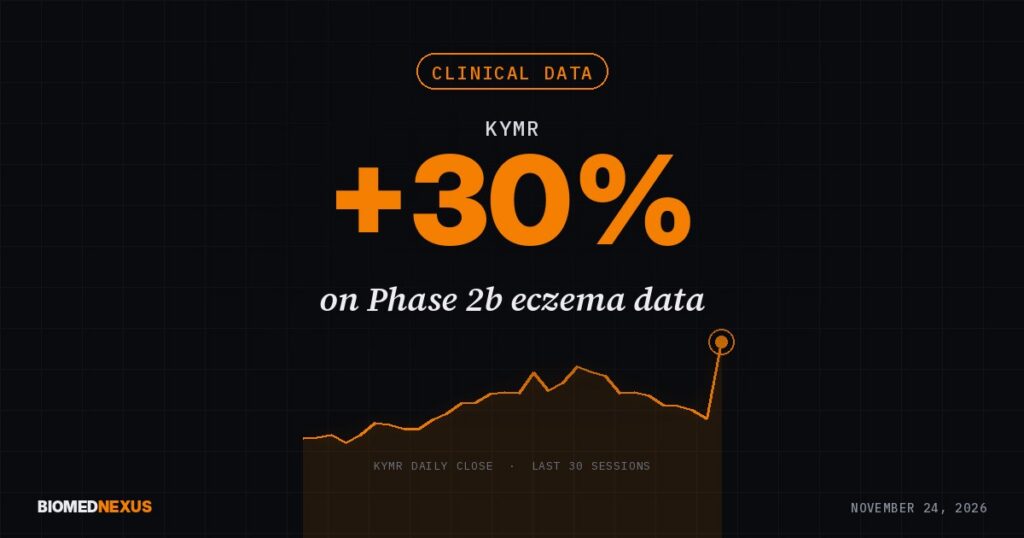
| KYMR | $173.92 | +15.7% | Second session after the zero discount $1.75B pricing; now 15.7% above the $150.37 issue price; no new disclosure found |
| MMED | $19.07 | +14.1% | FQ2 margin at 17.0% and first positive free cash flow as an independent |
| XBI | $156.82 | +6.6% | Sector traded the $41B deal as validation; SPY slipped 0.5% |
Frequently asked questions
What price is Sanofi paying for Insmed?
$175.00 per share in cash, a total equity value of approximately $41.0 billion (€37.6 billion), per the joint announcement of November 24, 2026.
When will the Sanofi Insmed deal close?
The companies expect closing in the first half of 2027, subject to Insmed shareholder approval and US and certain non US regulatory approvals.
Is the Sanofi Insmed deal a tender offer?
No. It is a merger agreement that goes to an Insmed shareholder vote. Financing is committed, through debt and cash on hand.
What premium does $175 per share represent for Insmed?
The release states no premium. Against Monday’s $149.09 close it is 17.4 percent; against the $119.80 close on November 18, the last session before Bloomberg reported Sanofi’s interest, it is 46.1 percent (our arithmetic).
What is Brinsupri and how big is it?
Brinsupri (brensocatib) is Insmed’s DPP1 inhibitor for non cystic fibrosis bronchiectasis, launched in the US in August 2025. The announcement states $1.09 billion in revenue through September 30, 2026.
Why did Sanofi’s stock rise on the acquisition?
Acquirers usually trade down on big deals. Sanofi’s ADR closed up 11.0 percent, and Reuters reported the Paris shares at a more than one year high, suggesting investors read the purchase of launched, de risked assets as good capital deployment.
What did the FDA approve Ekitna for?
Ekitna (bezuclastinib) with sunitinib for adults with advanced GIST previously treated with imatinib, approved November 24, 2026, six days ahead of its PDUFA date. The label carries a boxed warning for hepatotoxicity.
How much did Ekitna improve progression free survival in GIST?
Median PFS was 16.5 months with Ekitna plus sunitinib versus 9.2 months with sunitinib alone in the 413 patient PEAK trial, a hazard ratio of 0.50 (p<0.0001), per the FDA notice.
What is Welgemda approved for?
Welgemda (BBP-418, ribitol) received traditional FDA approval for limb girdle muscular dystrophy type 2I/R9 in adult and pediatric patients weighing at least 30 kg, announced November 23, 2026. BridgeBio calls it the first approved treatment for any form of LGMD.
Did BridgeBio get a priority review voucher with the Welgemda approval?
Yes. The FDA issued a Rare Pediatric Disease Priority Review Voucher with the approval, per BridgeBio’s release.
What did the FDA approve Wilserdly for in breast cancer?
Single agent adjuvant treatment of adults with ER positive, HER2 negative early stage breast cancer at intermediate to high risk of recurrence. In lidERA, giredestrant cut the risk of invasive disease recurrence or death by 30 percent versus standard endocrine therapy.
Did the FDA reject Savara’s molgramostim?
No. The agency missed its November 22 action date and told Savara the review remains ongoing with no revised date, per PharmExec and Reuters. A missed PDUFA date is not a rejection.
How did MiniMed perform in fiscal Q2 2027?
Revenue of $822 million, up 9.7 percent organic, adjusted EBITDA margin of 17.0 percent, GAAP EPS of $0.08, and the first positive free cash flow quarter ($55 million) as an independent company. Full year guidance was reaffirmed.
When does the MiniMed Fit tubeless pump launch?
MiniMed moved the US launch forward from summer to spring 2027 after the FDA cleared Fit several months early, with an early customer experience phase starting in fiscal Q4 2027.
Sources
- Sanofi press release, November 24, 2026 (sanofi.com; also carried at investor.insmed.com): deal terms, financing, product figures, quotes
- FDA approval notice, November 24, 2026 (fda.gov, cancer approvals): Ekitna indication, PEAK efficacy and safety, designations
- Cogent Biosciences 8-K exhibit, August 10, 2026 (sec.gov): PDUFA dates, PEAK detail, Grade 3 transaminase rates
- BridgeBio Pharma 8-K exhibit 99.1, November 23, 2026 (sec.gov): Welgemda approval, FORTIFY results, PRV, launch plans
- Roche media release, November 23, 2026 (roche.com): Wilserdly adjuvant approval, lidERA results
- MiniMed press release, November 24, 2026 (news.minimed.com): fiscal Q2 2027 results, guidance, Fit launch timing
- PharmExec, November 24, 2026, citing Reuters November 20: Savara PDUFA miss; Savara disclosure dated November 20
- CNBC, Fierce Pharma, BioPharma Dive, November 24, 2026: deal characterizations (attributed in text)
- Earnings Whispers preview, November 16, 2026: MiniMed consensus figures (attributed)
- Exchange settled closing prices, November 24, 2026; all percentage moves our arithmetic