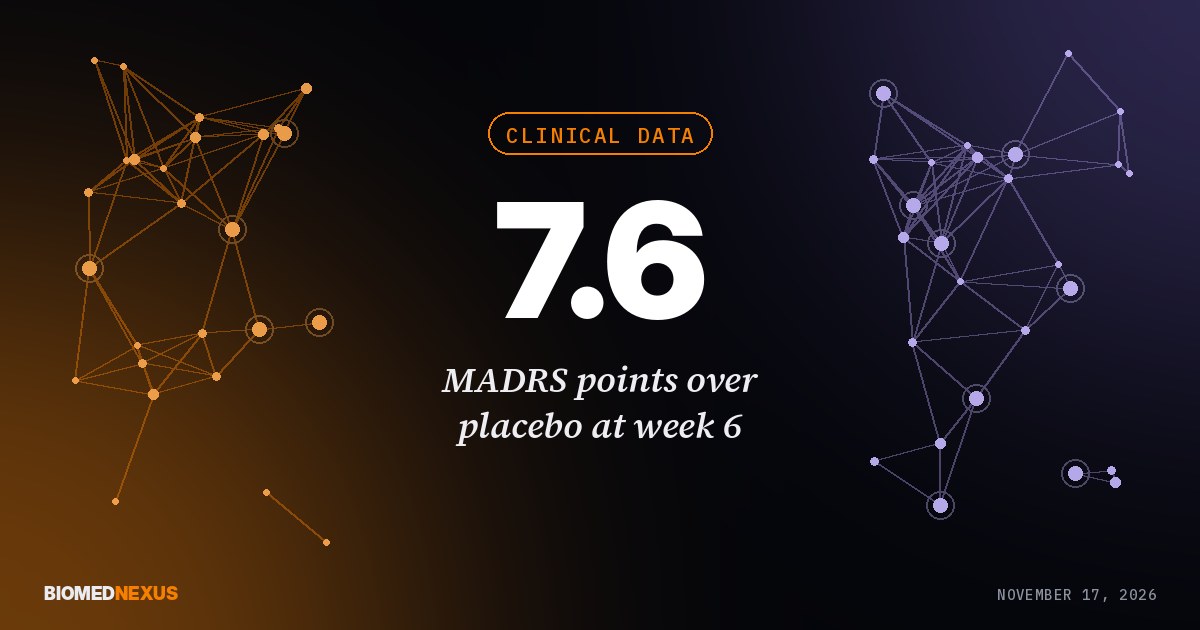
Helus Pharma’s deuterated psilocin HLP003 beat placebo by 7.6 MADRS points in the Phase 3 APPROACH study on November 16, 2026, and the stock fell 13.5%.
Last updated: November 17, 2026
In the Phase 3 APPROACH study reported November 16, 2026, Helus Pharma’s HLP003 reduced MADRS scores by 19.5 points versus 11.9 for placebo at week 6, a 7.6 point placebo adjusted benefit (p<0.0001). Helus shares still closed down 13.5% at 7.67.
This report covers the full APPROACH dataset, Summit Therapeutics’ first session after the ivonescimab complete response letter, the ObesityWeek 2026 fallout for Novo Nordisk, Amylyx and Viking, Lexeo’s LX2020 regulatory agreement, and Monday’s movers.
What did the Phase 3 APPROACH study of HLP003 show?
APPROACH met its primary endpoint and every key secondary. HLP003, added to a stable antidepressant, cut MADRS scores 19.5 points at week 6 versus 11.9 for placebo, a 7.6 point difference with p<0.0001 and an effect size of 0.653, with separation visible at Day 2.
APPROACH was a multicenter, randomized, double blind, placebo controlled Phase 3 trial in 222 adults with moderate to severe major depressive disorder (MADRS of at least 24 at screening and baseline) who stayed on a stable dose of their existing antidepressant throughout. Baseline MADRS was 32.7 in the HLP003 arm (n=112) and 33.8 on placebo (n=110). The primary endpoint was least squares mean change in MADRS total score at week 6; the key secondary ran to week 12.
| Endpoint | HLP003 (n=112) | Placebo (n=110) | Difference / p value |
|---|---|---|---|
| MADRS reduction, Day 2 | 16.1 points | 11.0 points | −5.0, p=0.0013, effect size 0.438 |
| MADRS reduction, week 6 (primary) | 19.5 points | 11.9 points | −7.6, p<0.0001, effect size 0.653 |
| MADRS reduction, week 12 (key secondary) | 16.9 points | 9.9 points | −7.0, p<0.0001, effect size 0.581 |
| Response (≥50% reduction), week 6 | 56.3% | 28.2% | p<0.0001 |
| Remission (MADRS ≤10), week 6 | 50.9% | 18.2% | p<0.0001 |
| Remission, week 12 | 40.2% | 15.5% | p<0.0001 |
Response and remission also separated at Day 2 (response 50.0% versus 23.6%, p=0.0002; remission 39.3% versus 15.5%, p=0.0002), and Clinical Global Impression scores were statistically significant versus placebo from Day 2 onward. Roger S. McIntyre of the University of Toronto said in the company’s release that the results “set a new benchmark for what may be achievable with adjunctive treatment in major depressive disorder.”
What is HLP003 and who is Helus Pharma?
HLP003 is deuterated psilocin, the lead asset in what Helus calls novel serotonergic agonists: synthetic molecules designed to activate serotonin pathways believed to promote neuroplasticity. It holds FDA Breakthrough Therapy Designation for adjunctive treatment of major depressive disorder.
Helus Pharma is the company formerly known as Cybin, which completed a legal name change and moved its primary listing to Nasdaq under the ticker HELP, per the company’s announcements and trade coverage of the rebrand; HLP003 was previously designated CYB003. APPROACH is the first of three studies in the Phase 3 PARADIGM program. EMBRACE, the second pivotal study, is ongoing with topline expected in the fourth quarter of 2027, and EXTEND is the long term extension covering durability and the potential role of redosing. The company also has HLP004 in Phase 2 for generalized anxiety disorder. The release gave no NDA submission timing.
How safe was HLP003 in the APPROACH study?
The release describes HLP003 as generally well tolerated, with most adverse events mild to moderate, transient, and primarily limited to the day of dosing. There were three treatment related serious adverse events, and the company says no new safety signals were identified.
The topline release did not include discontinuation rates or an adverse event table, so the full tolerability picture waits on the data presentations. The day of dosing pattern matters commercially: it points to an administered, monitored treatment model rather than a take home prescription, which is central to how the category will be priced and delivered if approved.
Why did Helus stock fall after positive Phase 3 results?
Helus closed Monday at 7.67, down 13.5% from Friday’s 8.87, on volume of about 12.8 million shares against a recent daily norm near one million. The decline came despite the positive topline and against a broadly weak tape: XBI fell 3.1% and SPY fell 1.9%.
The company disclosed nothing negative alongside the data, and we do not assign a cause the record does not support. What the record does show: the stock opened above 9.00, touched 9.57, and sold to a 6.90 low before settling, a 28% intraday range on roughly thirteen times normal volume. The open questions a buyer confronts are a missing NDA timeline, a second pivotal reading out in late 2027, an in clinic delivery model, and three treatment related serious adverse events not yet characterized by rate. All moves computed by us from exchange settled closes.
What happened to Summit Therapeutics after the ivonescimab CRL?
Summit’s first session after Sunday’s complete response letter closed at 11.82, down 16.5%. From its November 11 close of 16.64, the stock has given up 29% over four sessions. Both figures are our arithmetic from settled closes.
The FDA refused the ivonescimab BLA in EGFR mutated non small cell lung cancer because the HARMONi trial’s overall survival result was a positive trend without statistical significance, and the agency said a progression free survival benefit alone does not establish effectiveness in this setting. Summit’s release named no resubmission plan or timeline, which leaves the ongoing HARMONi-3 study as the asset’s next counted number in the US. Chairman Robert Duggan’s position, in the company’s release, is that the data across five positive Phase 3 studies has not changed. Monday’s close is the market’s first settled answer to that argument.
What did Novo’s CagriSema data at ObesityWeek 2026 show?
A post hoc analysis of REDEFINE 1, released November 15, tied early response to final outcome: participants with at least 5% weight loss by week 8 on CagriSema averaged 25.4% weight loss at week 68, versus 17.8% for delayed responders. Novo also confirmed the FDA decision on CagriSema is expected in the fourth quarter of 2026.
In the analysis, 67.8% of CagriSema treated participants (n=1,367) were early responders, and 73.3% of them reached at least 20% weight loss at week 68, versus 37.2% of delayed responders (n=649). Women were more likely to be early responders (71.8% versus 59.5%). The figures are observed, on treatment data that Novo labels hypothesis generating. REDEFINE 1 was a 68 week Phase 3 trial of CagriSema 2.4 mg/2.4 mg weekly in 3,417 adults with overweight or obesity and no type 2 diabetes. Discontinuation for adverse events was 5.9% versus 3.5% on placebo, with gastrointestinal events in 79.6% versus 39.9%. In a separate release, Novo said the lower dose REDEFINE 9 trial showed about 21% average weight loss, published in The Lancet Diabetes and Endocrinology; we could not retrieve that release body, so the figure is attributed to Novo’s headline. The NDA was filed in December 2025.
| REDEFINE 1 post hoc (week 68, observed) | Early responders (n=1,367) | Delayed responders (n=649) |
|---|---|---|
| Mean weight loss at week 8 | 7.8% | 3.4% |
| Mean weight loss at week 68 | 25.4% | 17.8% |
| Achieved ≥20% at week 68 | 73.3% | 37.2% |
How did Amylyx, Viking and Rhythm trade after ObesityWeek?
The first sessions after positive weekend data were all red: Amylyx closed at 27.80, down 8.2% after Saturday’s LUCIDITY Phase 3 win, and Viking closed at 26.80, down 8.3% after Sunday’s VK2735 presentations. Novo ended flat at 41.60. Rhythm fell 6.6% to 107.48 without releasing anything.
Amylyx’s avexitide data stands unchanged: a 55% reduction in composite hypoglycemia events (p=0.0000034) in post bariatric hypoglycemia, with an NDA planned by year end. Viking’s VENTURE data showed 74% of subcutaneous VK2735 participants improving at least one BMI category, with the VANQUISH Phase 3 program completing in 2027. Rhythm’s newest press release remains the November 4 NICE guidance update; we checked the company’s investor relations news page Monday night and found no ObesityWeek 2026 data release, so setmelanotide and bivamelagon watchers got silence while the stock declined. ObesityWeek concludes Tuesday, November 17, with Corbus’ CANYON-1 late breaker still to come.
What did Lexeo announce about LX2020 and why did the stock rise?
Lexeo rose 12.5% to 3.23 after reporting interim Phase 1/2 data for LX2020, its gene therapy for PKP2 arrhythmogenic cardiomyopathy, alongside an FDA agreement in principle on the registration path: the agency is open to guideline defined NSVT as a primary surrogate endpoint in an accelerated approval pivotal study.
In the HEROIC-PKP2 study (NCT06109181), ten participants have been dosed, and the seven high dose participants showed an 80% mean reduction in nonsustained ventricular tachycardia and a 44% mean reduction in PVC burden at latest assessment, with data cut October 15, 2026. No participant discontinued; a previously disclosed Grade 3 ventricular tachycardia serious adverse event occurred three months after dosing and resolved with treatment. Pivotal design finalization is expected in the first half of 2027 and study initiation in the second half, with cash of $219.1 million expected to fund operations into 2028. On a day when three positive Phase 3 datasets sold off, the market’s one biotech reward went to a company whose news was an agreed, countable endpoint.
Which stocks moved on November 16, 2026?
Moves that carried a story, computed by us from exchange settled closes against Friday’s closes:
| Ticker | Monday close | Move | Context |
|---|---|---|---|
| HELP | 7.67 | −13.5% | Day of positive Phase 3 APPROACH topline |
| SMMT | 11.82 | −16.5% | First session after the ivonescimab CRL |
| AMLX | 27.80 | −8.2% | First session after LUCIDITY Phase 3 win |
| VKTX | 26.80 | −8.3% | First session after ObesityWeek VK2735 data |
| LXEO | 3.23 | +12.5% | LX2020 interim data and FDA endpoint agreement |
| WWB | 30.04 | +5.4% | Second full session; 76.7% above the $17.00 IPO price (ours) |
| XBI / SPY | 145.88 / 739.95 | −3.1% / −1.9% | Sector and market context |
What else happened on November 16, 2026?
BioXcel has announced nothing either way on the Igalmi at home sNDA, now two days past the November 14 action date; our check covered searches and press release listings through Monday night. Innovent received a positive CHMP opinion for sintilimab (Zybrivo) in first line nonsquamous non small cell lung cancer, per the company’s release, a Chinese PD-1 moving toward the EU market. China’s 2026 reimbursement list additions included Zai Lab’s KarXT and VYVGART Hytrulo and seven Innovent products including mazdutide, per company releases; Zai’s US shares fell 4.6%. Among last week’s new issues, Surrozen closed at 32.32, above its $31.67 offering price, and Rezolute closed at 3.58, below its $3.87 print; neither company, nor Windward nor InspireMD, had posted an offering closing release by Monday night (we checked Rezolute’s investor news page directly; Surrozen’s blocks automated reading). China’s MOFCOM comment period on the draft biotech export control catalogue closed November 15 with no final catalogue published that we could find.
Frequently asked questions
What were the topline results of the Helus APPROACH study?
HLP003 reduced MADRS scores by 19.5 points at week 6 versus 11.9 for placebo, a 7.6 point placebo adjusted difference (p<0.0001, effect size 0.653), with every key secondary endpoint also met.
What is HLP003?
HLP003 is deuterated psilocin, a synthetic serotonergic agonist developed by Helus Pharma (formerly Cybin) as an adjunctive treatment for major depressive disorder, taken alongside a stable antidepressant. It holds FDA Breakthrough Therapy Designation.
How fast did HLP003 work in the APPROACH trial?
Separation from placebo was statistically significant at Day 2, when HLP003 patients had already dropped 16.1 MADRS points versus 11.0 for placebo (p=0.0013), and the benefit held through week 12.
What remission rates did HLP003 achieve?
Remission (MADRS of 10 or less) was 50.9% versus 18.2% for placebo at week 6, and 40.2% versus 15.5% at week 12.
Were there serious adverse events in the APPROACH study?
Yes. The company reported three treatment related serious adverse events, said most adverse events were mild to moderate and limited primarily to the day of dosing, and identified no new safety signals. Rates were not detailed in the topline release.
Is HLP003 approved by the FDA?
No. HLP003 is investigational. APPROACH is the first of three Phase 3 studies in the PARADIGM program, and Helus has not stated an NDA submission date.
When will the second HLP003 pivotal study read out?
EMBRACE, the second pivotal study, is ongoing with topline results expected in the fourth quarter of 2027, per the company.
Why did Helus stock drop after positive results?
The company disclosed no negative news; the stock fell 13.5% on about thirteen times normal volume, on a day XBI fell 3.1%. The open items a buyer faces are the absent NDA timeline, a late 2027 second pivotal, and an in clinic dosing model.
Why did the FDA reject Summit’s ivonescimab?
The FDA said substantial evidence of effectiveness is not established without a statistically significant overall survival improvement, and that the HARMONi trial’s progression free survival benefit alone does not support approval in EGFR mutated non small cell lung cancer.
What is Summit Therapeutics’ stock price after the CRL?
Summit closed at 11.82 on November 16, 2026, down 16.5% in its first session after the complete response letter and down 29% over four sessions, by our arithmetic from settled closes.
When will the FDA decide on CagriSema?
Novo Nordisk says the FDA decision on CagriSema for weight management is expected in the fourth quarter of 2026, from an NDA filed in December 2025.
What did the CagriSema early responder analysis show?
Participants with at least 5% weight loss by week 8 averaged 25.4% weight loss at week 68, versus 17.8% for delayed responders, in observed REDEFINE 1 data that Novo calls hypothesis generating.
What did the FDA agree to on Lexeo’s LX2020?
Per Lexeo, the FDA is open to guideline defined nonsustained ventricular tachycardia as a primary surrogate endpoint for an accelerated approval pivotal study in PKP2 arrhythmogenic cardiomyopathy, with the pivotal expected to start in the second half of 2027.
Did BioXcel get a decision on the Igalmi at home sNDA?
Nothing has been announced either way as of Monday night, November 16, two days past the November 14 action date. Silence past an action date is itself information, and we are watching for the disclosure.
When does ObesityWeek 2026 end?
ObesityWeek 2026 runs November 14 to 17 in Washington, DC, concluding Tuesday with late breakers including Corbus’ CANYON-1.
Sources
Primary sources: Helus Pharma topline release, GlobeNewswire, November 16, 2026 (figures quoted from the release body); Summit Therapeutics BLA update release, Business Wire, November 15, 2026; Novo Nordisk REDEFINE 1 post hoc release, PR Newswire, November 15, 2026; Lexeo Therapeutics Q3 2026 and LX2020 release, investor site, November 16, 2026; Rhythm Pharmaceuticals investor news page, checked November 16, 2026; exchange settled closing prices, November 16, 2026 (all percentage moves our arithmetic).
Trade coverage and attributed items: Fierce Biotech on the Cybin to Helus rebrand; Novo Nordisk REDEFINE 9 release headline (body not retrieved); Innovent CHMP opinion release carry; Zai Lab and Innovent NRDL release carries; BioSpace press release listings, November 15 to 16, 2026.