The FDA granted accelerated approval to J&J’s Rybrevant Faspro for recurrent or metastatic head and neck cancer on November 5, 2026, on a 42% response rate.
Last updated: November 6, 2026
On November 5, 2026, the FDA granted accelerated approval to Rybrevant Faspro, subcutaneous amivantamab, for recurrent or metastatic head and neck squamous cell carcinoma after platinum chemotherapy and a PD-1 or PD-L1 antibody, excluding HPV associated oropharyngeal cancer, on a 42% response rate.
This page covers November 5, 2026: the Rybrevant Faspro approval, the AI driven market selloff, Reuters reporting on AstraZeneca’s offer for Rhythm Pharmaceuticals, Viatris and BD results, liver disease data, and the Karyopharm delisting timeline.
What did the FDA approve Rybrevant Faspro for on November 5, 2026?
The FDA granted accelerated approval to amivantamab and hyaluronidase-lpuj, sold as Rybrevant Faspro by Johnson & Johnson’s Janssen Biotech, for adults with recurrent or metastatic head and neck squamous cell carcinoma whose disease progressed on or after platinum based chemotherapy and a PD-1 or PD-L1 antibody. The label excludes HPV associated oropharyngeal squamous cell carcinoma.
The approval rests on OrigAMI-4 (NCT06385080), a multicenter, open label, multi cohort trial. The primary efficacy population was 102 patients, with HPV associated oropharyngeal cancer excluded on p16 testing. By blinded independent central review, the overall response rate was 42% (95% CI: 32 to 52), and 56% of responders held their response for six months or longer. Patients received single agent, weight based subcutaneous dosing every three weeks until progression or unacceptable toxicity.
The application carried priority review and breakthrough therapy designation and was reviewed under Project Orbis alongside regulators in Brazil, Canada, Israel and Singapore. The FDA notice names no confirmatory trial; as an accelerated approval, continued approval will depend on confirmatory evidence. Johnson & Johnson’s release, which crossed at 9:03 pm Eastern, calls the drug the first and only dual targeted therapy for advanced head and neck cancer, a company characterization. Prescribing information carries warnings for hypersensitivity and administration related reactions, interstitial lung disease, dermatologic reactions, ocular toxicity and embryo fetal toxicity.
| OrigAMI-4 primary efficacy population | Result |
|---|---|
| Patients (recurrent or metastatic HNSCC, HPV associated OPSCC excluded) | 102 |
| Overall response rate (BICR, RECIST v1.1) | 42% (95% CI: 32 to 52) |
| Responders with duration of response at six months or longer | 56% |
| Prior therapy required | Platinum based chemotherapy and a PD-1 or PD-L1 antibody |
| Dosing | Single agent, weight based, subcutaneous, every three weeks |
Timing matters for the tape: the FDA notice posted at 5:32 pm Eastern and the company release at 9:03 pm, both after the close. Johnson & Johnson’s Thursday close of $272.32, down 1.4%, predates the news, so Friday is the first reaction session.
How big was the November 5 stock market selloff?
Thursday was the worst session of the year. The S&P 500 fell 4.4% and the Nasdaq dropped about 5% into correction territory as the selloff in artificial intelligence stocks resumed, with the Dow losing roughly 1,800 points, per wire service reports. Health care gave back Wednesday’s midterm rally almost in full.
The round trip is the story for this sector. Amgen, which on Wednesday became the first major to clear higher on an earnings beat this season, closed at $460.28, down 3.8% and below where it traded before its print (our arithmetic from settled closes). XBI fell 6.7% to 148.40, erasing Wednesday’s 2.7% gain and more. The repricing that followed Tuesday’s Democratic sweep lasted exactly one session before the AI trade took the market’s full attention.
| Mover | Nov 5 close | Change | Context |
|---|---|---|---|
| Karyopharm (KPTI) | $0.0601 | −17.6% | Fourth straight decline into the November 11 Nasdaq suspension; down 90.9% from October 30 |
| Summit Therapeutics (SMMT) | $14.19 | −12.2% | Risk off into the November 14 ivonescimab decision; no disclosure found |
| Illumina (ILMN) | $208.00 | −8.2% | Second sharp decline (12.7% over two sessions); no new disclosure found; its October 29 report raised 2026 guidance |
| Rhythm (RYTM) | $105.02 | −5.1% | Gave back part of the bid pop; still 21.5% above the pre report close |
| BD (BDX) | $213.55 | +2.1% | Green on results day against a 4.4% market decline |
| XBI / SPY | 148.40 / 733.00 | −6.7% / −4.4% | AI selloff resumed; Nasdaq entered correction |
All closes are official exchange settled prices; percentage moves are our arithmetic. Illumina’s slide has no cause we could find in company disclosures as of Thursday night; its third quarter report, released October 29 after the close, raised full year guidance to $4.64 to $4.66 billion in revenue and $5.40 to $5.45 in adjusted earnings per share.
What is AstraZeneca’s reported offer for Rhythm Pharmaceuticals?
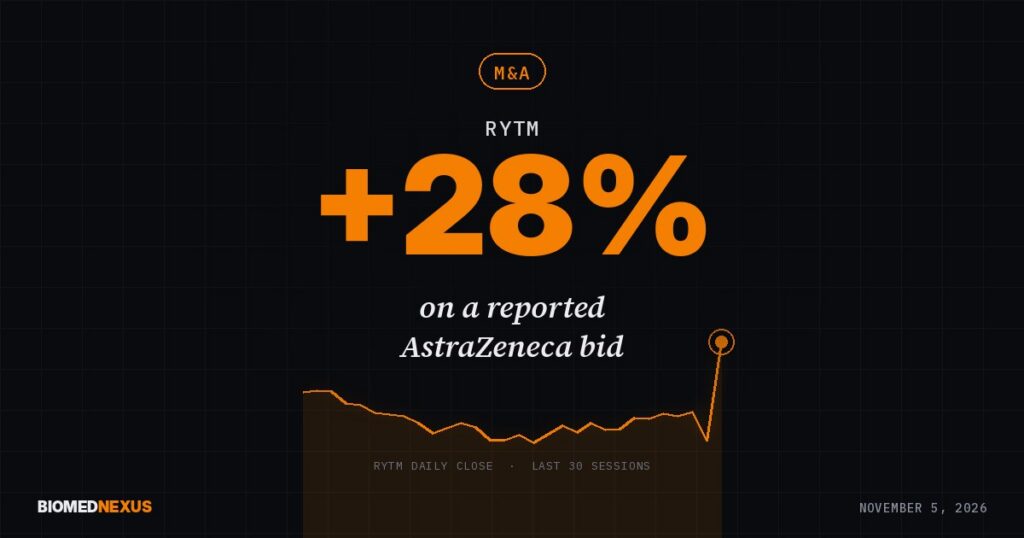
Reuters, citing three people familiar with the matter, reported that AstraZeneca has made a nonbinding offer of about $10 billion for Rhythm Pharmaceuticals, worth as much as $134 per share including milestone payments, and that the acquisition would run through its rare disease unit Alexion. The Wall Street Journal reported Wednesday that AstraZeneca offered $124 per share last month. Neither company has commented.
The two figures describe different constructions and are not reconciled by either outlet, so we present them separately. The $134 number includes contingent milestone payments; the Journal’s $124 figure was reported without that breakdown. Against Thursday’s $105.02 close, the reported figures imply spreads of 18.1% and 27.6% respectively, our arithmetic. Jefferies analyst Michael Leuchten called the approach to rare disease assets that fit AstraZeneca’s existing footprint entirely sensible, and said the March 2026 US approval of Imcivree in acquired hypothalamic obesity materially changed Rhythm’s proposition beyond ultra rare genetic obesity.
| Reported construction | Source | Per share | Notes |
|---|---|---|---|
| Nonbinding proposal, about $10 billion | Reuters, three sources | Up to $134 including milestones | Pursued through Alexion per two of the three sources |
| Offer made last month | Wall Street Journal | $124 | AstraZeneca renewed its pursuit in recent months |
Two near term checkpoints are on the calendar. Rhythm said in its November 4 release that it expects the initial $250 million draw on its credit facility on Friday, November 6, a step that reads like a company planning an independent future. And final Phase 3 data for setmelanotide in acquired hypothalamic obesity arrive at ObesityWeek, November 14 to 17, a dataset any bidder would be watching.
Did Viatris raise its 2026 guidance?
Yes. Viatris raised the midpoints of its 2026 guidance on every metric alongside third quarter results: total revenues of $3.75 billion, flat year over year, adjusted earnings of $0.71 per share, up 6%, and adjusted EBITDA of $1.20 billion, up 4%. The company recorded a GAAP net loss of $325.3 million, driven primarily by a higher income tax provision.
| 2026 guidance | August 6 midpoint | November 5 midpoint |
|---|---|---|
| Total revenues | $14,750M | $14,800M |
| Adjusted EBITDA | $4,400M | $4,500M |
| Adjusted EPS | $2.52 | $2.60 |
| Free cash flow excluding transaction and restructuring costs | $2,200M | $2,300M |
Three operational items stand out. First, the Pacira BioSciences acquisition, $36.50 per share in cash for an aggregate equity value of $1.65 billion, is expected to close by the end of November 2026, and guidance excludes any Pacira contribution. Second, the FDA classified the Nashik, India oral solid dose facility as Official Action Indicated; Viatris voluntarily suspended manufacturing there in October, took roughly $100 million of revenue impact in the third quarter, expects about another $100 million in the fourth, and plans to resume production in the first quarter of 2027. Third, new products delivered about $115 million in the quarter and are now expected at approximately $450 million for the full year, and the release cites October’s FDA approval of RYZUMVI for presbyopia, the franchise Viatris licensed from Opus Genetics. The stock closed at $18.97, down 1.3%, a relative outperformance on a day the market fell 4.4%.
How did BD close its first year as a pure play medtech company?
BD reported fiscal fourth quarter revenue of $5.27 billion, up 5.6% currency neutral, and full year fiscal 2026 revenue of $19.46 billion, up 3.9% currency neutral, with full year adjusted earnings of $12.70 per diluted share, up 6.7%. Chairman and CEO Tom Polen said fiscal 2026 completed BD’s transformation to a more focused medtech company after the February 9 spin of its Biosciences and Diagnostic Solutions business and that unit’s combination with Waters.
For fiscal 2027, the first full year guide on the New BD basis, the company expects low single digit revenue growth and adjusted earnings of $13.10 to $13.30 per share, which works out to growth of 3.1% to 4.7%, our arithmetic from the company’s table. Free cash flow rose 42.5% to $2.93 billion, the company bought back $2.43 billion of stock, and long term debt fell to $13.4 billion.
The policy content is as interesting as the numbers. BD says it intends to invest $19 billion in the United States over several years, with $3 billion directed to manufacturing expansion, in exchange for relief from future Section 232 tariffs on covered products and inputs, subject to final scope and milestones. The year also included a $66 million benefit from refunds of IEEPA tariffs. Among the segments, Interventional grew 7.6% in the quarter and Advanced Patient Monitoring grew 15%, while Medication Management Solutions declined 2.3%. An investor day is set for December 10 at the New York Stock Exchange. The stock closed up 2.1% at $213.55 on a day the S&P 500 fell 4.4%.
What did Gilead’s IDEAL trial show for Livdelzi in second line PBC?
IDEAL met its primary endpoint decisively. In 96 adults with primary biliary cholangitis whose alkaline phosphatase remained above normal but below 1.67 times the upper limit of normal despite a year of ursodeoxycholic acid, or who could not tolerate it, 75.4% of Livdelzi patients reached the ALP normalization composite at week 52 versus 16.1% on placebo.
Gilead calls IDEAL the first clinical trial of Livdelzi, its seladelpar franchise, in people with inadequately controlled disease below the usual second line threshold. Response at one month was 52.3% versus 6.5%, serious adverse events were lower on drug than on placebo, 3.1% versus 12.9%, with none deemed treatment related, and the results have been accepted for publication in the Journal of Hepatology. Gilead says it is engaging with global regulatory authorities, language that points toward a label expansion push. The data lead a heavy liver disease weekend: The Liver Meeting 2026 runs November 5 to 9 in Denver.
Two more datasets frame the week. Amylyx restated its positive LUCIDITY topline alongside third quarter results: avexitide cut the composite rate of Level 2 and Level 3 hypoglycemic events by 55% versus placebo (p=0.000003) in post bariatric hypoglycemia, with all secondary endpoints met. The topline itself was disclosed earlier in the quarter; what is new is the company confirming its NDA remains on track for year end, a late breaking oral at ObesityWeek on November 15, and a cash position of $768.1 million. And Vir Biotechnology said it will present topline Phase 3 ECLIPSE 1 data for elebsiran and tobevibart in chronic hepatitis delta at the meeting and host an investor call; the numbers were not in Thursday’s announcement, so that readout lands over the weekend with the outcome unknown as of this writing.
When does Karyopharm stop trading on Nasdaq?
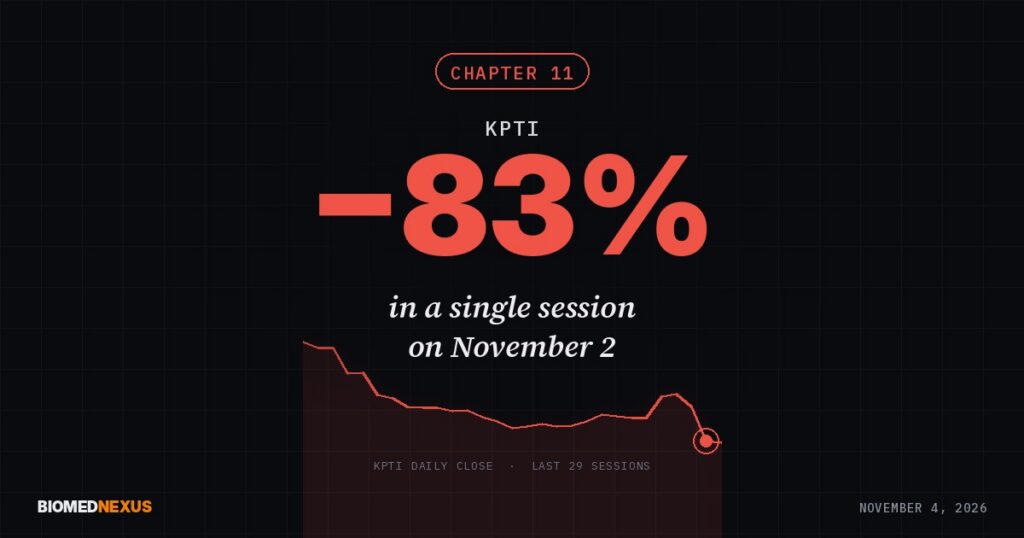
Trading in Karyopharm shares will be suspended at the opening of business on November 11, 2026, and the stock is expected to move to over the counter markets under the symbol KPTIQ, according to the company’s November 5 securities filing. Nasdaq issued its delisting notice on November 4 and Karyopharm will not appeal.
The filing confirms the Chapter 11 petitions and the joint prepackaged plan were filed on November 2 in the Southern District of Texas, and states plainly that holders of common stock and the Series A convertible preferred will not receive any payment or other distribution, that the company expects its equity to have no value, and that trading in it is highly speculative. The shares fell another 17.6% on Thursday to $0.0601, down 90.9% from their October 30 close, our arithmetic. We could not verify the status of first day interim orders from the bankruptcy court as of Thursday night; the November 5 filing covers only the delisting.
Frequently asked questions
What is Rybrevant Faspro?
Rybrevant Faspro is amivantamab and hyaluronidase-lpuj, a subcutaneous formulation of Johnson & Johnson’s bispecific antibody targeting EGFR and MET, co formulated with an enzyme that allows under the skin dosing in place of intravenous infusion.
Who is eligible for Rybrevant Faspro in head and neck cancer?
Adults with recurrent or metastatic head and neck squamous cell carcinoma whose disease progressed on or after platinum based chemotherapy and a PD-1 or PD-L1 antibody. Patients with HPV associated oropharyngeal squamous cell carcinoma are excluded from the indication.
Why are HPV associated oropharyngeal cancers excluded from the approval?
The OrigAMI-4 primary efficacy population excluded HPV associated oropharyngeal cancer based on p16 testing, so the FDA matched the label to the studied population. HPV associated disease has a distinct biology and generally better prognosis.
What response rate supported the Rybrevant Faspro approval?
A 42% overall response rate with a 95% confidence interval of 32 to 52 in 102 patients, by blinded independent central review, with 56% of responders maintaining response for at least six months.
Is the Rybrevant Faspro approval full or conditional?
It is an accelerated approval granted on response rate, a surrogate endpoint. Continued approval can be made contingent on confirmatory evidence of clinical benefit. The FDA notice does not name the confirmatory trial.
How much is AstraZeneca reportedly offering for Rhythm Pharmaceuticals?
Reuters reports a nonbinding proposal of about $10 billion, up to $134 per share including milestone payments, while the Wall Street Journal reported a $124 per share offer made in October. Neither company has confirmed or denied the reports.
Why did the stock market fall on November 5, 2026?
Wire reports attribute the drop to a resumed selloff in artificial intelligence stocks. The S&P 500 fell 4.4%, the Nasdaq entered correction territory, and the Dow lost roughly 1,800 points, pulling health care’s midterm rally back down with it.
What did Viatris say about the Pacira acquisition closing?
Viatris expects the $36.50 per share, $1.65 billion equity value acquisition of Pacira BioSciences to close by the end of November 2026, with minimal impact on its gross leverage ratio at closing.
How large is the revenue impact from the Viatris Nashik facility suspension?
About $100 million in the third quarter and approximately another $100 million expected in the fourth quarter, after Viatris voluntarily suspended manufacturing at the FDA cited Indian plant in October. Production is expected to resume in the first quarter of 2027.
What is BD’s guidance for fiscal 2027?
Low single digit revenue growth and adjusted earnings of $13.10 to $13.30 per diluted share, the company’s first full year guidance on the New BD basis after the Waters spin of its biosciences and diagnostics business.
What is BD’s Section 232 tariff agreement?
BD says it intends to invest $19 billion in the United States over several years, including $3 billion for manufacturing expansion, and in return receives relief from future Section 232 tariffs on covered products, subject to the final scope of any tariff actions and to BD meeting agreed milestones.
What did the IDEAL trial test that earlier Livdelzi trials did not?
IDEAL enrolled primary biliary cholangitis patients whose alkaline phosphatase was elevated but below 1.67 times the upper limit of normal, a group with inadequately controlled disease that sits below the threshold used in prior second line trials.
When does Amylyx plan to file avexitide with the FDA?
Amylyx reiterated on November 5 that it remains on track to submit the NDA for avexitide in post bariatric hypoglycemia by the end of 2026, with full LUCIDITY data presented at ObesityWeek on November 15 and a potential launch in 2027 if approved.
What happens to Karyopharm shareholders in the Chapter 11?
Under the prepackaged plan filed November 2, holders of common stock and the Series A convertible preferred receive no payment or distribution. The company itself expects its equity securities to have no value.
When is the next readout in the hepatitis delta race?
Vir Biotechnology will present topline Phase 3 ECLIPSE 1 data for elebsiran and tobevibart at The Liver Meeting 2026, which runs November 5 to 9 in Denver, and will hold an investor call. The results were not disclosed in Thursday’s announcement.
Sources
- FDA, Center for Drug Evaluation and Research: accelerated approval notice for amivantamab and hyaluronidase-lpuj in recurrent or metastatic HNSCC, November 5, 2026 (primary)
- Johnson & Johnson press release, November 5, 2026, 9:03 pm Eastern, via wire feed (company primary; first and only dual targeted therapy characterization)
- Reuters, November 5, 2026 (carried by The Manila Times): AstraZeneca offer reporting, three sources; Wall Street Journal reporting as cited therein (attributed; not company confirmed)
- Viatris third quarter 2026 earnings release, November 5, 2026, SEC Form 8-K exhibit 99.1 (primary)
- BD fourth quarter and full year fiscal 2026 results, November 5, 2026, SEC Form 8-K exhibit 99.1 (primary)
- Gilead Sciences press release on Phase 3 IDEAL results, November 5, 2026, via Business Wire (primary)
- Amylyx Pharmaceuticals third quarter 2026 release, November 5, 2026, SEC Form 8-K exhibit 99.1 (primary)
- Karyopharm Therapeutics Form 8-K, event date November 4, 2026, filed November 5, 2026 (primary)
- Illumina third quarter fiscal 2026 release, October 29, 2026, via PR Newswire carry (primary content; dated context)
- Regeneron Form 8-K filing index, filed October 30, 2026 (primary; dating reference)
- Associated Press, CNBC and Fox Business market reports, November 5, 2026 (attributed market context)
- Settled closing prices: official exchange closes; all percentage calculations are our arithmetic
Related coverage
- Rhythm jumped 28% on the first report of the AstraZeneca takeover bid
- Karyopharm filed Chapter 11 and shareholders get nothing
- Voceryq sent Inovio up 214% and rival Precigen down 26%
- Retatrutide doubled Ozempic’s weight loss in a head to head trial
- Iovance fell 35% after its lung cancer data matched last year’s