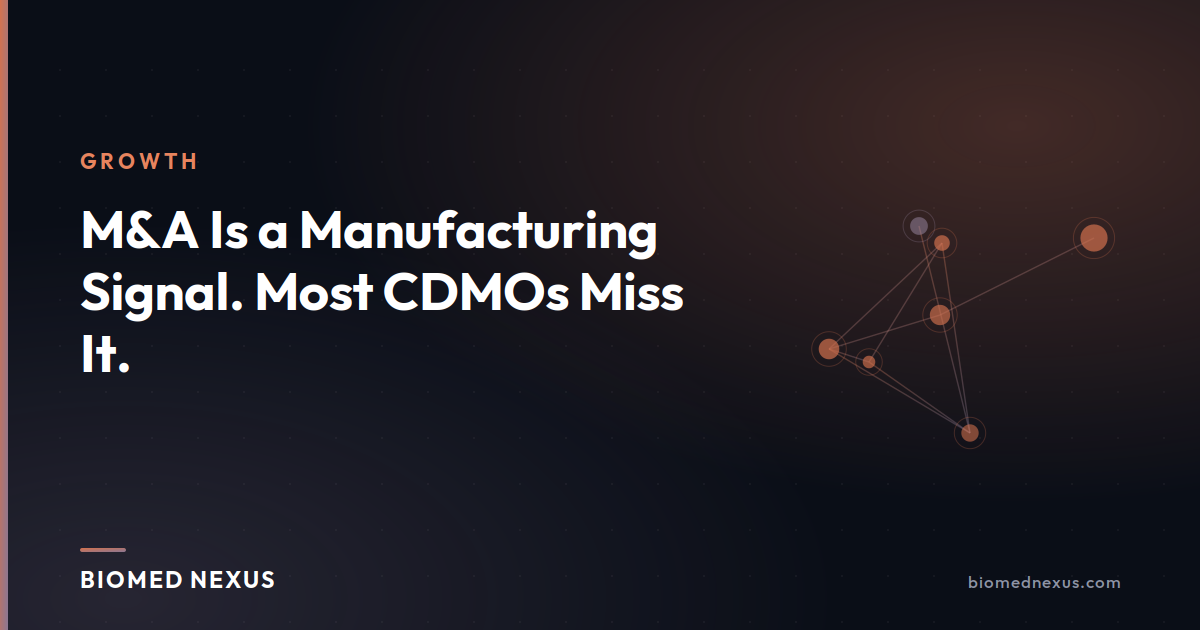
When a pharma company acquires a biotech, they inherit a molecule and, very often, a manufacturing arrangement that no longer makes sense. That is a CDMO opportunity with a date attached, and most CDMOs never even notice it happened.
What an acquisition actually creates
Read an acquisition as an operational event rather than a news item and the opportunities are obvious.
The acquired company’s supply arrangements come under review. Technology transfers get planned. Capacity that was adequate for a small biotech is suddenly inadequate for a commercial launch under a large pharma’s timeline. Redundant vendors get cut and preferred partners get consolidated. Someone, quite soon, has to answer the question of who is going to make this at scale.
The signals inside the signal
- The modality tells you immediately whether it is your problem. An oral small molecule, a biologic, a cell therapy, an ADC. Each implies completely different manufacturing needs.
- The stage tells you the urgency. An asset with an NDA filing expected within a year needs commercial scale-up now, not eventually.
- The acquirer’s footprint tells you whether they will make it internally or need a partner. Not every acquirer has capacity for every modality, and that gap is your opening.
- The integration timeline tells you the window. Supply decisions get made during integration, not after.
Why nobody calls
Not because CDMOs do not read the news. They do. The failure is in translation.
A BD team reads “Pharma X acquires Biotech Y for $900M” and files it under interesting. Nobody converts it into: this is an oral small molecule, the acquirer will need commercial supply for a 2027 launch, the transfer will happen during integration, and the person to call is the VP of Technical Operations, this quarter.
That translation step is the entire job, and almost nobody does it systematically.
The call that works
You are not congratulating them on the deal. You are demonstrating that you already understand the manufacturing problem they are about to have, that you have handled that modality at that scale, and that you know what a transfer of this type actually involves. That is a conversation a technical operations lead will take, because you are speaking to a problem already on their whiteboard.
Know who to call
Every acquisition this quarter created a manufacturing decision with a deadline. Someone will win that work. It may as well be you.
Get Signals for your BD team, $8,000/year for up to 5 seats
Or a single seat, $2,500/year
Every Friday: 15 to 20 tagged signals, a “Who To Call This Week” list of 10 prioritized targets with the trigger and a suggested opening line, and a monthly outreach playbook. Two-week free trial, no commitment. See also the buying signals biotech vendors keep missing.
Frequently asked questions
Why is M&A a buying signal for CDMOs?
Because an acquisition creates a manufacturing problem with a deadline. Supply arrangements come under review, technology transfers get planned, capacity adequate for a small biotech becomes inadequate for a commercial launch, and someone must decide who will manufacture at scale, usually during integration rather than after.
What should a CDMO look for in an acquisition announcement?
The modality, which determines whether it is your problem at all; the stage, which sets the urgency, since an asset with an NDA filing within a year needs commercial scale-up now; the acquirer’s own manufacturing footprint, since a capability gap is your opening; and the integration timeline, because supply decisions get made during integration.
Why do CDMOs miss M&A opportunities?
Not because they do not read the news, but because the translation step never happens. A BD team reads that a pharma acquired a biotech and files it under interesting, without converting it into a specific conclusion about modality, scale-up timeline, and who to call this quarter. That translation is the entire job.